Childhood Is Not Preparing For Life. Childhood Is Life.
Why the experiences children have today are already shaping the adults they will become.
We often speak about childhood as though it were a waiting room.
Children are preparing for school. Preparing for adolescence. Preparing for adulthood. Preparing for the future. The language feels natural because it has become part of everyday conversation, quietly suggesting that childhood is primarily valuable because of what it eventually leads to. The most important part of life, we imply, is still ahead.
The developing brain experiences something very different.
It does not experience childhood as preparation. It experiences childhood as life itself.
Every conversation, every friendship, every disappointment, every moment of curiosity, every argument, every success, and every ordinary afternoon becomes part of the environment from which the brain is building its understanding of the world. Childhood is not an introduction to development. It is development unfolding in real time.
That distinction may seem subtle, yet it changes the way we think about almost everything.
When we imagine childhood as preparation, it becomes easy to believe that today's experiences matter mainly because of the adults children will eventually become. We focus on future outcomes, future achievements, and future wellbeing. We ask whether children will become resilient, emotionally healthy, motivated, or capable adults, as though those qualities are waiting quietly in the distance.
The developing brain does not wait.
It is constantly adapting to the experiences available today. Long before children understand themselves, they are already learning what relationships feel like. They are discovering how people respond when someone makes a mistake, what happens after conflict, how uncertainty is handled, and whether difficult emotions are something to hide, avoid, or move through. These lessons are rarely taught deliberately, yet they become part of the architecture through which children later understand themselves and other people.
Perhaps this is why ordinary experiences deserve far more attention than they often receive.
When adults think about childhood, we naturally remember the milestones. The first day of school, birthdays, family holidays, sporting achievements, and important celebrations stand out in our memories because they feel significant. The developing brain, however, is shaped just as much by experiences that never become family stories. It learns from dinner conversations that happen every evening, from the routines surrounding bedtime, from how disagreements are repaired, from moments of waiting, from laughter, from boredom, and from countless interactions that appear too ordinary to matter.
Repetition has always been one of childhood's greatest teachers.
The brain develops through patterns because patterns help it predict the world it is growing into. Experiences that happen repeatedly begin to feel normal, and whatever feels normal gradually becomes the foundation for expectations. Children begin developing expectations about how relationships work, how learning feels, how mistakes are handled, and what they should expect from themselves when life becomes difficult. None of these expectations appear overnight. They are built quietly through the accumulation of everyday experience.
This may be one of the reasons modern childhood deserves thoughtful attention.
Every generation grows up inside a different environment. Previous generations encountered one set of everyday experiences, while today's children are surrounded by another. The differences are easy to see when we look at technology, education, or entertainment, yet the more interesting question may be what these environments are repeatedly teaching developing brains. Every environment encourages certain experiences, reduces others, and creates patterns that gradually become part of childhood itself.
Children are not simply growing up around those environments.
They are growing up through them.
A child who regularly experiences patient conversations may gradually learn that understanding takes time. A child who repeatedly discovers that difficult tasks become easier through persistence develops a different relationship with effort than a child who rarely has those opportunities. A child who experiences emotional repair after conflict learns something about relationships that cannot be explained in a single conversation. In each case, development is taking place long before anyone thinks about preparing for adulthood.
The same principle applies to emotional development.
Children do not spend their early years practising emotions so they will be ready to feel them later. They experience joy, disappointment, fear, excitement, embarrassment, curiosity, and frustration as part of everyday life, and the brain gradually learns what those emotions mean through repeated experience. Emotional regulation is not postponed until adulthood. It begins in childhood because childhood is where emotional life first takes shape.
The same is true for motivation.
Children are not rehearsing motivation for the future. They are developing beliefs about effort, interest, persistence, and reward every time they encounter a challenge, discover something new, or decide whether to keep trying after something feels difficult. Those experiences gradually influence how they approach learning, relationships, and uncertainty throughout life.
Seen in this light, childhood begins to look less like a rehearsal and more like the first chapter of the adult life that is already being written.
This perspective also changes the role of parents, teachers, and communities.
Rather than seeing ourselves as preparing children for a future that has not yet arrived, we begin recognising that we are shaping the environments in which development is already happening. The conversations we have, the routines we create, the opportunities we provide for play, exploration, responsibility, rest, and connection all become part of the experiences from which children build their understanding of the world. None of us controls every influence in a child's life, yet every environment contributes something to the picture the developing brain is quietly assembling.
Perhaps that is one of the most hopeful aspects of child development.
It reminds us that meaningful change rarely depends upon extraordinary moments. Development has always been shaped by ordinary experiences repeated often enough to become part of everyday life. A calm conversation after an argument, an evening spent reading together, a child solving a problem independently, a shared family meal, or an afternoon of imaginative play may not feel remarkable in the moment. Yet these experiences become the threads from which childhood is woven, and over time they influence far more than we usually imagine.
Perhaps this is the shift modern childhood asks us to make.
Instead of asking whether today's experiences are preparing children for tomorrow, we might begin asking what those experiences are already building today. The developing brain is not waiting for childhood to end before it begins shaping the adult. It is doing that work every single day, responding to the environments, relationships, and experiences that surround it.
Childhood has never been separate from life.
It has always been the beginning of it.
Children Feel Our Nervous Systems Before They Understand Our Words
Why emotional regulation begins long before children understand emotional advice.
Long before children understand words like patience, stress, calm, or emotional regulation, they are already learning from them.
Not from their definitions, but from the people around them.
One of the remarkable things about early childhood is that the developing brain begins learning through relationships long before language is able to explain what it is experiencing. Children recognise comfort before they can describe safety. They notice tension before they understand stress. They respond to the pace of another person's voice, the expression on a parent's face, and the rhythm of everyday interactions long before they have the vocabulary to explain why those moments make them feel settled or unsettled.
In many ways, the nervous system becomes one of childhood's first teachers.
When we think about how children learn, it is natural to picture conversations. We explain why kindness matters, encourage them to be patient, remind them to use their words, and help them understand their emotions. These conversations are important because language gradually gives children a way to organise their experiences. Yet long before those explanations begin making sense, another form of learning has already been taking place.
Children are watching how emotions move through the people they depend upon.
They notice what happens when someone becomes frustrated. They observe whether disagreements become louder or calmer over time. They experience what follows disappointment, uncertainty, excitement, and stress. None of these moments feel like formal lessons, yet the developing brain is constantly collecting them, quietly building expectations about how emotions usually unfold and what relationships feel like when emotions become intense.
This may be one of the reasons emotional regulation is so often misunderstood.
We sometimes speak about regulation as though it were a skill that begins when children are old enough to understand advice. We teach breathing exercises, encourage children to count to ten, or remind them to calm down before reacting. Those strategies certainly have their place, but they arrive relatively late in development. Long before children can use those techniques independently, they have already spent years experiencing how emotions are handled inside the relationships surrounding them.
The brain learns through repetition because repetition provides predictability.
If a child repeatedly experiences that frustration is followed by reassurance, that conflict is followed by repair, or that fear is met with calm support rather than panic, those experiences gradually become part of the child's internal understanding of how the world works. Over time, the nervous system begins expecting that emotions are temporary rather than permanent, manageable rather than overwhelming, and something that can be shared rather than faced alone.
This process is often described as co-regulation, but the idea itself is beautifully simple.
Before children consistently regulate themselves, they are regulated with someone else.
That is not a weakness or a sign that something is missing. It is one of the most fundamental features of healthy development. Human beings have always learned emotional regulation inside relationships. Infants do not calm themselves because they understand breathing techniques. They calm because someone holds them, speaks softly, rocks them, or simply remains emotionally available until the intensity begins to settle. Thousands of these ordinary moments gradually teach the developing brain that emotional storms have beginnings, middles, and endings.
Those experiences become memories long before they become conscious knowledge.
Perhaps this is why children often respond more strongly to our emotional state than to our words. A parent can quietly say, "Everything is okay," but if their voice is tense, their breathing becomes shallow, and their movements communicate urgency, children frequently respond to those signals long before they evaluate the sentence itself. The nervous system developed to notice patterns that help us understand whether we are safe, and much of that information has always travelled through tone, pace, facial expressions, and behaviour rather than language.
This does not mean parents need to remain calm all the time.
In fact, that may be one of the most reassuring aspects of child development. Children do not need perfect regulation. They need authentic regulation. There is an important difference between those two ideas because life inevitably includes stress, disappointment, conflict, and emotional overwhelm. The goal has never been to prevent children from witnessing those moments. The goal is to allow them to witness something equally important.
Recovery.
Children learn just as much from seeing adults find their way back to calm as they do from seeing calm in the first place. They learn that people can apologise after speaking too sharply. They learn that difficult conversations can end in connection rather than distance. They discover that stress changes, that emotions move, and that relationships remain intact even after challenging moments. Those experiences quietly teach something no explanation ever could.
Emotions are not dangerous because they are temporary.
That lesson may become one of the foundations of emotional resilience.
As children accumulate hundreds and eventually thousands of these experiences, the nervous system begins responding differently to future challenges. Not because children have memorised advice about emotions, but because they have lived through emotions often enough to develop confidence that they will eventually pass. Emotional regulation gradually becomes less about following instructions and more about trusting an internal pattern that has been strengthened through repeated experience.
Seen in this light, parenting begins to look slightly different.
Perhaps one of the most valuable questions is not whether we always respond perfectly, but what patterns our children experience most often. Do they repeatedly discover that emotions can be talked about without shame? Do they experience repair after conflict? Do they see adults become overwhelmed and then find their way back? Do they learn that relationships remain safe even when feelings become complicated?
These are not dramatic moments.
Most families experience them quietly, in kitchens, cars, bedrooms, school runs, and ordinary evenings that will probably never be remembered individually. Yet childhood has never been shaped primarily by extraordinary events. It has always been shaped by the ordinary experiences that repeat themselves often enough to become expectations.
Perhaps that is why emotional regulation begins much earlier than we often imagine.
It begins long before children understand advice about emotions because the developing brain is already learning from the emotional environments in which childhood unfolds. Long before children can explain what regulation means, they are experiencing what regulation feels like. Those experiences gradually become part of the way they understand themselves, other people, and the world around them.
Children may eventually remember the advice we gave them.
Before that happens, however, they spend years learning from something much quieter.
They feel our nervous systems long before they understand our words.
The Skills Childhood Practises Are Changing
Every generation develops inside a different environment. Today's children are practising a different set of everyday skills than previous generations.
Every generation grows up inside a world that quietly teaches them how life usually works.
Some generations grew up waiting days for letters to arrive. Others remember television programmes that aired only once a week, long car journeys without entertainment, or afternoons that seemed to stretch endlessly before friends finally knocked on the door. None of these experiences were designed to teach patience, imagination, or sustained attention. They were simply ordinary parts of everyday life, and because they happened so often, children practised those skills without anyone deliberately trying to teach them.
Today's childhood unfolds inside a very different environment.
Questions are answered within seconds. Music, films, games, and conversations are available almost instantly. Navigation rarely requires remembering directions, and uncertainty often lasts only as long as it takes to type a question into a search bar. Increasingly, even creativity, homework, and problem-solving are supported by technologies capable of responding immediately. These developments have brought remarkable opportunities, and few people would willingly give up the advantages they provide.
Yet they also invite a different kind of question.
What if the most important change is not what children are using, but what they are practising every day?
Child development has always been shaped by repetition. The developing brain does not simply learn from important events. It learns from ordinary experiences that occur so frequently they begin to feel invisible. Whatever childhood asks children to do again and again gradually becomes easier, more familiar, and eventually more automatic. Skills strengthen because they are repeatedly required, not because someone decided they were important.
This is true for language, relationships, emotional regulation, and attention. It is equally true for patience, frustration tolerance, navigation, memory, imagination, and sustained effort. These abilities are not built during occasional lessons. They grow through everyday life.
That perspective changes the conversation about modern childhood.
Perhaps we spend too much time asking whether children are using technology and too little time asking which skills their environments are asking them to practise most often. Every environment has its own curriculum, even if nobody writes it down. It quietly rewards certain behaviours, makes particular abilities more useful than others, and gradually shapes the experiences through which children learn about themselves and the world around them.
Consider something as simple as waiting.
For much of human history, waiting was woven into ordinary life. Children waited for birthdays, television programmes, photographs to be developed, libraries to open, buses to arrive, and relatives to visit. Waiting was rarely enjoyable, but it was unavoidable. Without intending to, childhood provided countless opportunities to discover that anticipation could be tolerated and that not every desire was fulfilled immediately.
Many aspects of modern life reduce those moments quite naturally. Films begin whenever we choose to watch them. Messages are delivered instantly. Information appears within seconds, and shopping, entertainment, and communication increasingly happen with very little delay. These changes make everyday life more efficient, yet they also mean that waiting may no longer occupy the same place in childhood that it once did.
The same pattern appears elsewhere.
Children today may practise navigating digital environments far more than navigating physical ones. They often become highly skilled at finding information while needing fewer opportunities to remember it. They may communicate with friends throughout the day while spending less time experiencing the natural pauses that once existed between conversations. None of these developments are inherently good or bad. They simply represent a different pattern of repeated experience.
The developing brain responds to patterns because that is how learning works.
Whatever happens frequently becomes familiar. Whatever becomes familiar gradually shapes expectations. Over time, those expectations influence how children approach new situations, solve problems, regulate emotions, and make sense of the world around them. This process has remained remarkably consistent throughout human history. What continues to change is the environment providing those repeated experiences.
That may be one reason discussions about childhood sometimes become unnecessarily polarised. One group argues that technology is transforming children for the worse. Another argues that every generation worries about change and that today's children are simply adapting to a different world. There is probably some truth in both perspectives, but they often overlook the more interesting question.
What kinds of experiences does today's environment make more common, and which experiences does it quietly make less common?
The answer is unlikely to be simple because modern childhood has expanded opportunities in countless ways. Children have access to extraordinary knowledge, creative tools, educational resources, and communities that previous generations could hardly imagine. At the same time, some experiences that once occurred naturally may now require more deliberate space. Unstructured play, extended conversations, boredom, sustained attention, independent exploration, and waiting are no longer guaranteed features of everyday life simply because the environment no longer requires them as often.
Perhaps this is why parenting today feels different from parenting a generation ago.
Parents are no longer shaping development only through the values they teach or the boundaries they set. They are also helping children navigate environments that are changing faster than childhood itself. The question is not whether children should grow up with technology. They already are. The more useful question is how we can ensure that modern childhood still contains opportunities to practise the experiences that developing brains have always needed.
That does not require rejecting the modern world.
It requires recognising that environments are powerful teachers.
If childhood naturally practises one set of skills more often than another, parents, schools, and communities can thoughtfully create opportunities for the experiences that have become less common. Time for conversation, imaginative play, meaningful responsibility, outdoor exploration, reading, creativity, and even moments of boredom are not attempts to recreate the past. They are ways of ensuring that childhood continues to provide a balanced education for the developing brain.
Perhaps this is one of the defining challenges of modern childhood.
Every generation inherits a different environment, and every environment shapes development in its own way. The goal has never been to preserve childhood exactly as it once was. The goal is to understand what today's childhood is quietly teaching so that we can intentionally protect the experiences that help children grow into curious, resilient, emotionally healthy, and adaptable adults.
Children have always learned from the worlds they grow up in.
The worlds themselves are what keep changing.
Children Don't Need Constant Happiness. They Need Emotional Safety.
Why emotional safety is often misunderstood in modern parenting.
Few ideas have become more influential in modern parenting than the desire to raise happy children.
It is an understandable goal. Every parent wants their child to enjoy life, feel secure, build healthy relationships, and grow into adulthood with a sense of wellbeing. When children laugh, play, and seem content, we naturally feel reassured that things are going well. When they become anxious, frustrated, or upset, our instinct is often to make those feelings disappear as quickly as possible.
The more I think about child development, however, the more I wonder whether happiness and emotional safety are two very different things.
They often appear together, but they are not the same. A child can be perfectly happy while feeling emotionally insecure, just as a child can feel deeply safe while crying after a disappointment. Happiness describes an emotion. Emotional safety describes the environment in which emotions are experienced.
That distinction may be one of the most important, and perhaps one of the most misunderstood, ideas in childhood development.
Children experience hundreds of emotions every week. Excitement, disappointment, jealousy, curiosity, frustration, pride, embarrassment, fear, joy, and sadness all appear as ordinary parts of growing up. None of these emotions are signs that something has gone wrong. They are part of how children gradually learn about themselves, about other people, and about the world they are trying to understand.
The developing brain is not designed to avoid emotion. It is designed to learn from it.
For that reason, emotional safety cannot mean protecting children from every uncomfortable feeling. If that were true, healthy development would be impossible because frustration, uncertainty, disappointment, and fear are woven into almost every important milestone of childhood. Learning to read is frustrating before it becomes enjoyable. Making friends involves misunderstanding and rejection as well as connection. Riding a bicycle usually includes falling over before balance begins to feel natural. Every meaningful skill asks children to spend time feeling incompetent before they become capable.
Those experiences are not interruptions to development.
They are development.
What matters is not whether children encounter difficult emotions. What matters is what those emotions are experienced alongside. A child who feels frightened while sitting next to a calm, supportive adult experiences something very different from a child who feels frightened and completely alone. A child who becomes overwhelmed but discovers that relationships remain steady begins learning something powerful about both emotions and people. The emotion eventually passes, and the connection remains.
Perhaps that is what emotional safety really is.
It is not the absence of sadness, anger, frustration, or fear. It is the growing expectation that these emotions can be experienced without losing love, connection, or support. Children gradually learn that difficult feelings are not emergencies. They are experiences that move through the nervous system, change over time, and become easier to understand when another person helps carry them.
This may explain why co-regulation plays such an important role in early childhood. Before children can consistently calm themselves, they borrow the emotional stability of the adults around them. They watch facial expressions, tone of voice, body language, and the pace at which adults respond. Long before children understand words like regulation or resilience, their brains are already learning an important lesson: What usually happens when emotions become big?
That lesson is repeated thousands of times.
If frustration is consistently met with patience, children gradually learn that frustration is manageable. If sadness is met with comfort rather than avoidance, sadness becomes less frightening. If mistakes are followed by encouragement instead of shame, children begin separating who they are from what they have done. These patterns rarely stand out in a single moment, yet together they become the foundation of emotional security.
This is one reason I believe modern parenting sometimes places too much emphasis on keeping children happy.
Happiness is a wonderful emotion, but it was never meant to be a permanent state. Childhood has always involved moments of boredom, disappointment, conflict, uncertainty, and failure. When we begin treating those experiences as problems to eliminate rather than opportunities to learn from, we may unintentionally communicate that uncomfortable emotions are signs that something is wrong.
Children notice those messages, even when nobody says them aloud.
If every tear immediately leads to distraction, every frustration is solved before it unfolds, or every disappointment is quickly replaced with something more enjoyable, children may gradually develop a very different relationship with emotion. Instead of learning that difficult feelings can be tolerated, they may begin expecting that difficult feelings should disappear as quickly as possible.
The difference is subtle, but it matters.
Emotional regulation does not begin when children learn techniques for calming themselves. It begins much earlier, when repeated experiences teach the developing brain that emotions are temporary, relationships remain stable during emotional moments, and discomfort does not automatically require escape.
This is where emotional safety and resilience begin to overlap.
Resilience is often described as the ability to recover from adversity, but recovery rarely happens in isolation. Children become resilient because they repeatedly experience that difficult moments can be survived without losing connection. They discover that adults remain available after mistakes, that conflicts can be repaired, and that overwhelming feelings eventually settle. Those experiences gradually become expectations, and those expectations shape how children respond to future challenges.
Seen in this light, emotional safety becomes less about creating perfect childhoods and more about creating reliable relationships.
Children do not need adults who prevent every difficult emotion from appearing. They need adults who remain emotionally available when those emotions inevitably arrive. They need to discover that fear does not drive caring people away, that disappointment does not make them less lovable, and that frustration is not something they have to face alone.
Perhaps that is one of the quiet strengths of emotionally safe environments.
They allow children to experience the full range of ordinary human emotions while gradually learning that those emotions are not dangerous. Over time, the nervous system begins responding differently because it has accumulated countless experiences demonstrating that emotional storms eventually pass and that connection survives them.
That may be one of the greatest gifts adults can offer the developing brain.
Not constant happiness.
But the confidence that every emotion, even the difficult ones, can exist within the safety of a relationship.
Perhaps that is what children have needed all along.
Children Don't Learn Confidence. They Build It.
Why confidence is often the result of experience—not the starting point.
Few qualities seem to matter more to parents than confidence.
We hope our children will believe in themselves, approach unfamiliar situations with curiosity rather than fear, and gradually become comfortable attempting things they have never done before. When they hesitate, we instinctively want to reassure them. When they doubt themselves, we look for the right words to help them feel more capable. Confidence is often treated as something children either possess or lack, and much of the advice given to parents begins from that assumption.
The more I think about child development, however, the more I wonder whether confidence works rather differently from the way we usually describe it. Perhaps confidence is not something children are given at all. Perhaps it is something they gradually build, almost without noticing, through hundreds of ordinary experiences that quietly reshape how they see themselves.
That distinction may appear subtle, yet it changes almost everything. If confidence is something adults give to children, then our task becomes protecting it and strengthening it through encouragement. If confidence is something children build for themselves, our role looks quite different. Instead of asking how we can make children feel more confident, we begin asking what kinds of experiences allow confidence to grow naturally over time.
Looking back at our own lives, confidence rarely arrived before experience. Very few adults learned to ride a bicycle because they already believed they could do it. They became confident after wobbling down the street, falling more than once, climbing back on, and eventually discovering that balance had quietly become something they no longer needed to think about. The same pattern appears throughout adulthood. We become comfortable speaking in front of other people after giving many presentations. We feel more capable at work after solving problems that once seemed intimidating. Confidence often appears only after experience has already done most of the work.
Children's development follows much the same pattern.
Throughout childhood, the brain is constantly collecting evidence about the world and about the child's own abilities. Every success contributes something to that picture, but so do mistakes, disappointments, recoveries, and repeated attempts. Over time, these experiences begin answering questions that children rarely ask out loud but are constantly exploring through everyday life. Can I cope when something feels difficult? What happens if I get something wrong? Does frustration mean I should stop, or does it usually pass if I keep going?
Those questions cannot be answered by encouragement alone. Warm, supportive relationships remain one of the most important foundations of healthy development because children need adults who believe in them long before they fully believe in themselves. Yet the developing brain does not rely only on words. It also compares those words with repeated experience, gradually deciding which beliefs are supported by evidence.
This may explain why genuine confidence feels different from confidence that depends entirely upon reassurance. A child who has repeatedly experienced overcoming manageable challenges begins trusting something deeper than praise. They remember learning to swim after being afraid of the water, reading books that once felt impossibly difficult, climbing higher than they thought they could, or returning to football practice after a disappointing game. None of those experiences seemed particularly important while they were happening, yet together they gradually became evidence that effort changes ability and that difficult experiences do not last forever.
Evidence is one of the most powerful teachers the developing brain has.
Every successful attempt quietly tells the brain, "You managed that." Every mistake followed by improvement teaches something equally valuable. "You didn't know how before, but you know a little more now." Over months and years, these experiences accumulate into an increasingly stable picture of who the child believes they are. Confidence grows not because children become convinced they will never fail, but because they repeatedly discover that failure is rarely the end of the story.
Seen from this perspective, struggle begins to look different as well. Modern parents naturally want to protect their children from unnecessary hardship, and few things are more difficult than watching a child feel disappointed or discouraged. Yet there is an important difference between protecting children from harm and protecting them from every experience that feels difficult. Healthy development has never depended upon childhood being free from challenge. It has depended upon children encountering challenges that stretch their abilities while remaining surrounded by relationships that provide safety, encouragement, and support.
This balance matters because confidence rarely develops during moments of complete comfort. It grows while children continue practising after getting something wrong, return to activities they almost abandoned, solve problems that initially seemed impossible, and slowly realise that today's frustration often becomes tomorrow's ordinary ability. Those moments may appear unremarkable from the outside, but they are exactly the kinds of experiences that gradually change how children think about themselves.
Perhaps this is why confidence is better understood as a relationship with experience than as a personality trait. Confident children are not children who believe they will always succeed. They are children who have accumulated enough evidence to expect that they can cope, adapt, and continue learning even when success is uncertain. They trust that confusion usually becomes understanding, that mistakes can be corrected, and that effort often changes what once seemed impossible.
This way of thinking also changes the kinds of questions we ask as parents. Instead of wondering how we can help children feel confident before attempting something difficult, we might ask whether they are collecting enough experiences to build confidence naturally. Instead of trying to remove every obstacle, we might think more carefully about which obstacles are actually providing opportunities for growth. The goal is not to make childhood harder, but neither is it to remove every challenge that contributes to healthy development.
Perhaps that is one of the quiet tensions of modern childhood.
Many aspects of everyday life are becoming faster, smoother, and more convenient than ever before. Technology answers questions almost instantly, navigation removes uncertainty, entertainment appears on demand, and many frustrations that previous generations simply accepted can now be avoided altogether. These developments have brought enormous benefits, yet convenience and development are not always trying to achieve the same thing. Convenience asks how quickly a problem can be solved. Development asks what the child learns while solving it.
That distinction feels increasingly important because confidence has never been built by reaching the destination as quickly as possible. It has been built by travelling the road that leads there. Every difficult conversation, every failed attempt, every skill patiently practised, and every obstacle gradually overcome provides another piece of evidence that the developing brain quietly stores away for the future.
Over time, those experiences become something far more valuable than a temporary feeling of confidence.
They become trust.
Not trust that life will always be easy, but trust that difficult things can be faced, learned from, and overcome. That kind of confidence cannot be handed to children through praise, reassurance, or good intentions alone. It grows slowly through experience, supported by caring relationships and strengthened every time children discover that they are capable of more today than they were yesterday.
Perhaps confidence has never been something children were meant to receive.
Perhaps it has always been something they build.
The Childhood Skill We May Be Accidentally Taking Away
What if the biggest change in modern childhood isn't what children are doing more of—but what they're doing less of?
When we talk about childhood today, the conversation often revolves around what children are exposed to.
We talk about screens, social media, artificial intelligence, online gaming, notifications, and endless streams of digital content. We ask whether these experiences are changing attention, motivation, emotional regulation, learning, or relationships. These are important questions, but they all begin from the same direction. They ask what modern childhood has added.
I sometimes wonder whether an equally important question receives far less attention.
What if one of the biggest changes in childhood is not what has been introduced, but what has quietly disappeared?
Child development has never been shaped only by extraordinary moments. Much of it unfolds through ordinary experiences that repeat themselves thousands of times. Waiting for dinner. Sitting through a long car ride. Trying again after getting something wrong. Feeling bored on a rainy afternoon. Building something that falls apart and starting over. Listening while someone else speaks. Living with questions that do not have immediate answers.
Most children never think of these moments as lessons.
Yet the developing brain may.
Childhood has always been filled with small periods of waiting, uncertainty, effort, and repetition. They were rarely enjoyable in the moment, but they offered something valuable. They gave children opportunities to practice skills that cannot simply be explained or taught. Patience grows by waiting. Persistence develops by continuing after frustration. Curiosity often deepens when answers are not immediately available. Imagination frequently begins when there is nothing obvious to do.
These experiences do not shape every child in the same way, nor should they be romanticised. Childhood has never been perfect, and no previous generation offers a blueprint we should simply recreate. Still, it is worth asking whether modern environments provide fewer natural opportunities to practice some of these developmental experiences than they once did.
Convenience has become one of the defining features of modern life.
Questions can be answered in seconds. Entertainment is available almost instantly. Navigation eliminates uncertainty. Shopping rarely requires waiting. Algorithms predict what we may enjoy before we have gone looking for it. Increasingly, technology is designed to reduce friction, save time, and make everyday life feel smoother.
For adults, many of these changes are genuinely beneficial.
For children, however, development is not only about reaching an outcome. It is also about experiencing the process that leads there.
A child who has to persist with a difficult puzzle is learning more than how the puzzle works. A child who waits for a turn in a conversation is practising self-regulation. A child who invents a game because there is nothing else to do is exercising creativity in ways that cannot be downloaded, streamed, or generated on demand.
From a developmental perspective, the process often matters just as much as the result.
The brain develops through repeated experience, not isolated events. Skills strengthen because they are used again and again in everyday life until they gradually become easier. This is true for language, emotional regulation, attention, problem-solving, and social interaction. It is also true for patience, frustration tolerance, sustained effort, and the ability to remain engaged when something is not immediately rewarding.
If opportunities to practise those experiences become less common, it is reasonable to ask what replaces them.
This is not an argument against technology, nor is it an invitation to feel guilty about modern parenting. Every generation raises children within the realities of its own time, and every era introduces new opportunities alongside new challenges. The goal is not to return to an earlier world but to understand the one children are growing up in today.
Perhaps that understanding begins with a different question.
Instead of asking whether modern childhood contains too much technology, perhaps we should also ask whether it contains enough opportunities for children to practise the experiences that have always helped developing brains grow stronger.
The answer will probably look different from one family to another.
Some children may find those opportunities through sport, music, creative hobbies, outdoor play, or long conversations around the dinner table. Others may discover them while building, drawing, reading, helping with everyday tasks, or simply having time to be bored without immediately escaping the feeling.
What matters is not the specific activity.
What matters is that childhood continues to include moments where growth happens slowly rather than instantly, where effort comes before mastery, and where satisfaction arrives because something meaningful has been worked for rather than immediately delivered.
Perhaps that is one of the most important questions modern parents can ask themselves.
Not simply, "What should I limit?"
But:
"What kinds of experiences does my child's developing brain still need regular opportunities to practise?"
Because childhood is not only shaped by what fills a child's day.
It is also shaped by what repeatedly gives the developing brain the chance to grow.
The First Generation to Grow Up With AI
What happens when artificial intelligence becomes part of a child's everyday environment?
Every generation grows up inside a world that feels perfectly ordinary to them.
Children born fifty years ago never questioned why there was only one television in the house, why photographs took days to develop, or why finding the answer to a question sometimes meant visiting a library. Those experiences did not feel unusual because they formed the background of everyday life. They were simply the environment childhood happened to unfold within.
The same has always been true throughout history. Childhood is never experienced against a blank canvas. It is shaped by the homes children grow up in, the communities surrounding them, the technologies available to them, and the countless routines that quietly become part of everyday life. Because each generation assumes its own environment is normal, profound changes often become visible only when we look back many years later.
I sometimes wonder whether we are living through one of those moments now.
Much of the current conversation about artificial intelligence focuses on what children are using it for. Can it help with homework? Will it improve education? Does it make learning easier? Could it become addictive? These are important questions, but they all begin from the same assumption—that AI is simply another tool children may choose to use.
History suggests something different often happens.
The most influential technologies rarely remain tools for very long. Gradually, they become part of the environment itself. Electricity stopped being an invention and became part of everyday life. The internet followed a similar path. Smartphones eventually became so ordinary that many adults now reach for them without consciously deciding to do so.
Artificial intelligence appears to be following the same pattern, perhaps even faster.
For the first time in history, children are beginning to grow up in a world where information does not simply exist. It responds. Questions no longer wait for a teacher, a parent, or a trip to the library. They can be answered instantly, at any hour of the day. Increasingly, those answers are delivered conversationally by systems that remember previous interactions, adapt their responses, and create the impression of an ongoing relationship rather than a single search.
That may prove to be one of the most significant differences between previous generations and this one.
Earlier technologies delivered content. Artificial intelligence participates in conversations.
At first glance, that distinction may seem relatively small. Yet from the perspective of child development, it could matter enormously because children do not simply learn from information. They learn from interaction. Long before they understand complex ideas, they are learning what conversations feel like, how questions are answered, how uncertainty is resolved, and what kind of responses they can expect when they seek help.
Every environment teaches those lessons, whether intentionally or not.
A child who grows up surrounded by patient conversations gradually develops expectations about listening, turn-taking, and reflection. A child who regularly experiences disagreement followed by repair learns something important about relationships. In much the same way, a child who becomes accustomed to immediate answers, personalised explanations, and endlessly available conversation may also begin developing expectations that extend far beyond technology itself.
None of this suggests that artificial intelligence is inherently beneficial or inherently harmful. Every major technological shift has brought opportunities as well as challenges. The more interesting question is not whether children should ever use AI, but how growing up alongside intelligent systems may quietly influence the expectations they carry into the rest of life.
Children rarely separate technology from the world around them.
Adults often speak about "screen time," "the internet," or "AI" as though these were distinct parts of life. Children experience something different. For them, these technologies simply become part of the environment in which friendships develop, questions arise, boredom appears, homework is completed, and curiosity is explored. They do not experience two separate worlds—one digital and one real. They experience one childhood unfolding across different spaces.
That distinction deserves more attention than it often receives.
When we ask whether AI will influence children, we sometimes imagine a future event that has not yet arrived. In reality, the more interesting question may be how children are already adapting to environments in which conversation, creativity, learning, and problem-solving increasingly include artificial intelligence as one participant among many.
The developing brain has always adapted to the environment surrounding it. It learns patterns before it understands them and gradually forms expectations about how the world normally behaves. That process has not changed. What is changing is the environment from which those patterns are being learned.
Perhaps that is why this conversation feels larger than artificial intelligence itself.
It is really a conversation about childhood.
Every generation inherits a different environment, and every environment quietly shapes the developing brain in different ways. The generation growing up today may become the first to spend their entire childhood alongside systems capable of answering questions, generating ideas, offering reassurance, assisting with learning, and participating in conversations at almost any moment of the day.
We do not yet know exactly how that will influence development over the coming decades.
What we do know is that environments have always mattered, and children have always learned from them long before they fully understood what they were learning. Artificial intelligence does not change that principle. It simply gives the developing brain a new kind of environment from which to learn.
Perhaps the question that will matter most is not whether children use AI.
It is what kind of childhood we create around it.
Children Learn Their Environment Long Before They Understand It
One of the most remarkable things about childhood is that children begin learning about the world long before they are able to explain it.
Long before they understand words such as patience, stress, uncertainty, emotional regulation, or resilience, their brains are already responding to them. Every ordinary day provides thousands of small experiences that gradually become part of how they understand the world. Most of those experiences seem insignificant when viewed in isolation, yet over months and years they accumulate into something far more important than individual memories. They become expectations about how life normally works.
This kind of learning rarely attracts much attention because it happens so quietly. Parents naturally focus on the lessons they know they are teaching. They encourage children to be kind, to tell the truth, to work hard, to apologise when they have hurt someone, and to treat other people with respect. Schools introduce reading, mathematics, science, and history. These are visible forms of learning, and because they are visible they are easy to recognise.
Running alongside them, however, is another kind of education that has no curriculum and no timetable. It takes place continuously, often without either adults or children noticing that it is happening. Every environment teaches something about the world to the developing brain, not through formal instruction but through repeated experience.
A child who grows up in a calm household does not simply experience calm. Gradually, they begin to expect that conversations can unfold without shouting, that disagreements can be repaired, and that moments of uncertainty do not necessarily signal danger. A child who regularly experiences patient encouragement while learning something difficult absorbs more than the skill itself. They also begin developing expectations about what learning feels like, how long improvement usually takes, and whether making mistakes is an ordinary part of the process or something to be avoided.
These lessons are rarely spoken aloud, yet they often become some of the most influential lessons childhood has to offer.
From the perspective of neuroscience, this should not surprise us. The developing brain is constantly searching for patterns because prediction is one of its most important jobs. Every repeated experience provides information about what is likely to happen next, allowing children to navigate an increasingly complex world with greater confidence. Rather than responding to every situation as though it were entirely new, the brain gradually builds an internal model of how the world usually behaves.
This ability is one of the reasons children learn so quickly. It allows language to develop, relationships to deepen, and everyday life to become more manageable. Without this remarkable capacity to recognise patterns, every conversation would feel unfamiliar and every new experience would demand the same amount of mental effort.
The same process, however, also explains why environments matter so profoundly. The brain learns from repetition rather than intention. It does not ask whether a pattern is helpful before incorporating it into its understanding of the world. It simply notices what happens often enough that it begins to expect it.
That simple observation changes the way we think about child development.
Children do not only learn that screens are entertaining. They also learn how quickly boredom can disappear. They do not only discover that answers can be found online. They begin developing expectations about how long uncertainty should last before it is resolved. They do not simply notice that messages receive immediate replies. Gradually, they absorb ideas about waiting, availability, attention, and the pace at which life unfolds.
None of these expectations are deliberately taught. They emerge naturally because repeated experiences slowly become the brain's definition of what is normal.
This may help explain why so many concerns that appear unrelated often seem to cluster together. Parents describe children who become discouraged quickly, struggle with waiting, avoid difficult tasks, lose interest more easily than expected, or become increasingly uncomfortable with boredom. Each behaviour has its own complexity and should never be reduced to a single explanation, yet it is worth considering whether they sometimes reflect something deeper than the behaviour itself.
Perhaps they reflect expectations that have developed gradually over thousands of ordinary experiences.
If waiting rarely lasts very long, waiting itself begins to feel unusual. If boredom is almost always interrupted by stimulation, boredom gradually becomes harder to tolerate. If uncertainty is consistently followed by immediate answers, uncertainty can begin to feel like a problem rather than a natural part of learning. None of these changes occur overnight, and none of them are caused by a single device, conversation, or experience. They emerge slowly as the developing brain adapts to the patterns surrounding it.
This is one reason I believe discussions about modern childhood sometimes become narrower than they need to be. We often ask whether a particular technology is good or bad, whether a specific activity should be encouraged or limited, or whether one parenting strategy is more effective than another. Those questions matter, but they may overlook something more fundamental.
The developing brain is always asking a quieter question.
"What kind of world do I live in?"
The answer is not constructed from lectures or advice. It is assembled gradually from everyday life. It is found in the pace of family conversations, in the rhythm of ordinary afternoons, in the way adults respond to frustration, in the amount of waiting children experience, and in the countless small interactions that seem too ordinary to matter.
By the time children are old enough to explain their environment, much of that environment has already become part of them.
Perhaps this is why prevention deserves to begin much earlier than we often imagine. Preventing future difficulties is not only about avoiding harmful experiences. It is also about creating repeated opportunities for children to learn that effort can become rewarding, that relationships can repair after conflict, that uncomfortable emotions can be tolerated, and that not every question requires an immediate answer.
These are not dramatic lessons.
Most parents teach them without ever realising they are teaching them.
Yet they may become some of the most enduring expectations children carry into adolescence and adulthood because they influence far more than behaviour alone. They quietly shape attention, motivation, resilience, emotional regulation, relationships, and ultimately the way children come to understand both the world and themselves.
For that reason, understanding child development may begin with a surprisingly simple observation. Children do not first analyse the environments around them and then decide what to believe. They live in those environments day after day until the patterns become familiar, and familiarity gradually becomes expectation.
Long before children understand the world, they are already learning what they should expect from it.
Children Don't Only Learn Behaviors. They Learn Expectations.
Every generation inherits a different childhood.
Some of the differences are immediately visible. Toys change. Schools change. Technology changes. The conversations taking place around the dinner table change. If we compare childhood today with childhood thirty or forty years ago, it is easy to notice how much of children's daily lives now unfolds in environments that simply did not exist for previous generations.
Other changes are far quieter. They happen gradually, almost invisibly, and because they rarely announce themselves, they often escape our attention altogether. Yet these quieter changes may shape development just as profoundly as the more obvious ones. Long before children develop firm opinions about themselves, they are gradually developing expectations about the world they inhabit. Those expectations are built through ordinary experiences repeated thousands of times until they begin to feel less like experiences and more like reality itself.
A child does not simply discover that a screen is entertaining. They also learn how quickly boredom can disappear. They do not only learn that answers can be found online. They begin developing expectations about how long uncertainty should last before it is resolved. They do not merely notice that a message can be answered immediately. They gradually absorb ideas about waiting, availability, and how quickly another person should respond.
Nobody deliberately teaches these lessons. No parent sits down and explains how much patience should be required before something becomes enjoyable. No teacher delivers a lesson about how uncomfortable frustration ought to feel or how long disappointment should last before it begins to fade. Nevertheless, children learn these things every day because the brain is remarkably sensitive to patterns. Whatever happens repeatedly begins to feel normal, and whatever feels normal quietly becomes an expectation about how the world works.
I sometimes wonder whether this is one of the most overlooked aspects of child development. When adults think about learning, we usually picture knowledge and skills. We imagine children learning to read, solving mathematical problems, developing language, making friends, or understanding right from wrong. Those forms of learning are important, but underneath them another process is taking place continuously. Children are not only learning what to think or how to behave. They are gradually learning what kind of world they expect to wake up in tomorrow.
That distinction may seem subtle, but I suspect it matters because it changes the questions we ask. Instead of focusing only on the behaviours we can observe, we begin paying closer attention to the environments quietly shaping those behaviours long before they become visible.
From a neuroscience perspective, the developing brain is constantly building predictions. It learns from repetition because prediction is one of the most efficient ways of navigating an increasingly complex world. Experiences that occur frequently become the brain's best guide to what will probably happen next. In many ways this is one of the brain's greatest strengths. Without it, every conversation, every classroom, and every new situation would feel as unfamiliar as the first.
The difficulty is that the brain does not carefully separate expectations that support healthy development from expectations that simply reflect the environment in which a child happens to be growing up. It learns from what is repeated, not from what is ideal. That is why environments deserve far more attention than they often receive.
A child who repeatedly experiences conversations unfolding slowly begins to understand that meaningful conversations take time. A child who regularly discovers that difficult tasks become enjoyable only after persistence develops a very different relationship with effort than someone who rarely has that opportunity. When disappointment is followed by support rather than immediate escape, children gradually discover something equally important: difficult emotions are not necessarily problems that must be removed as quickly as possible. They are experiences that can be lived through.
The opposite patterns teach just as effectively. If boredom is almost always followed by immediate stimulation, boredom itself begins to feel less tolerable. If uncertainty is consistently replaced by immediate answers, waiting for understanding can begin to feel strangely uncomfortable. If frustration is interrupted before children have the opportunity to experience themselves moving through it, they may simply have fewer opportunities to discover that frustration often resolves without needing to disappear instantly.
None of this means that modern technology is inherently harmful, nor does it suggest that previous generations somehow experienced a perfect childhood. Every generation grows up within environments that shape development in different ways. The important point is not whether change is good or bad. It is recognising that change teaches, because children are always learning from the environments surrounding them, even when nobody believes they are being taught anything at all.
Perhaps that is why so many concerns that appear unrelated often seem connected beneath the surface. Parents describe children who struggle to wait, who lose interest quickly, who avoid difficult tasks, who become discouraged by small setbacks, or who seem increasingly dependent upon immediate reassurance. Each behaviour can be understood on its own, but it is also possible that many of them reflect something deeper than behaviour itself.
They may reflect expectations. If the world is expected to move quickly, slow progress naturally feels frustrating. If enjoyment is expected to arrive immediately, activities that unfold gradually become harder to appreciate. If reassurance is expected to be constantly available, uncertainty may begin to feel less like an ordinary part of life and more like something that requires immediate resolution.
Seen through that lens, the conversation changes quite dramatically. Instead of asking only how we can change children's behaviour, we begin asking what expectations their daily environments are quietly teaching them. We become curious not only about individual moments, but about the patterns that those moments create over months and years. That shift in perspective feels important because expectations influence far more than isolated behaviours. They shape motivation, persistence, emotional regulation, relationships, and eventually even the way children understand themselves.
Today's children are growing up in environments unlike anything previous generations experienced. They have access to extraordinary technologies, remarkable opportunities, and more information than any generation before them. Those developments have brought enormous advantages, but they have also created patterns that the developing brain cannot help learning from. Whether those patterns ultimately strengthen resilience or make certain experiences more difficult will depend less on the technology itself than on how it becomes woven into everyday childhood.
Perhaps one of the most valuable things adults can do is become more aware of what children are already learning without anyone ever intending to teach it. Children do not only remember the lessons we deliberately provide. They also absorb the expectations hidden within ordinary routines, everyday environments, and repeated experiences that seem too small to matter. Those quiet expectations may eventually shape far more of childhood than we realise because they quietly influence how children approach effort, relationships, uncertainty, disappointment, and ultimately themselves.
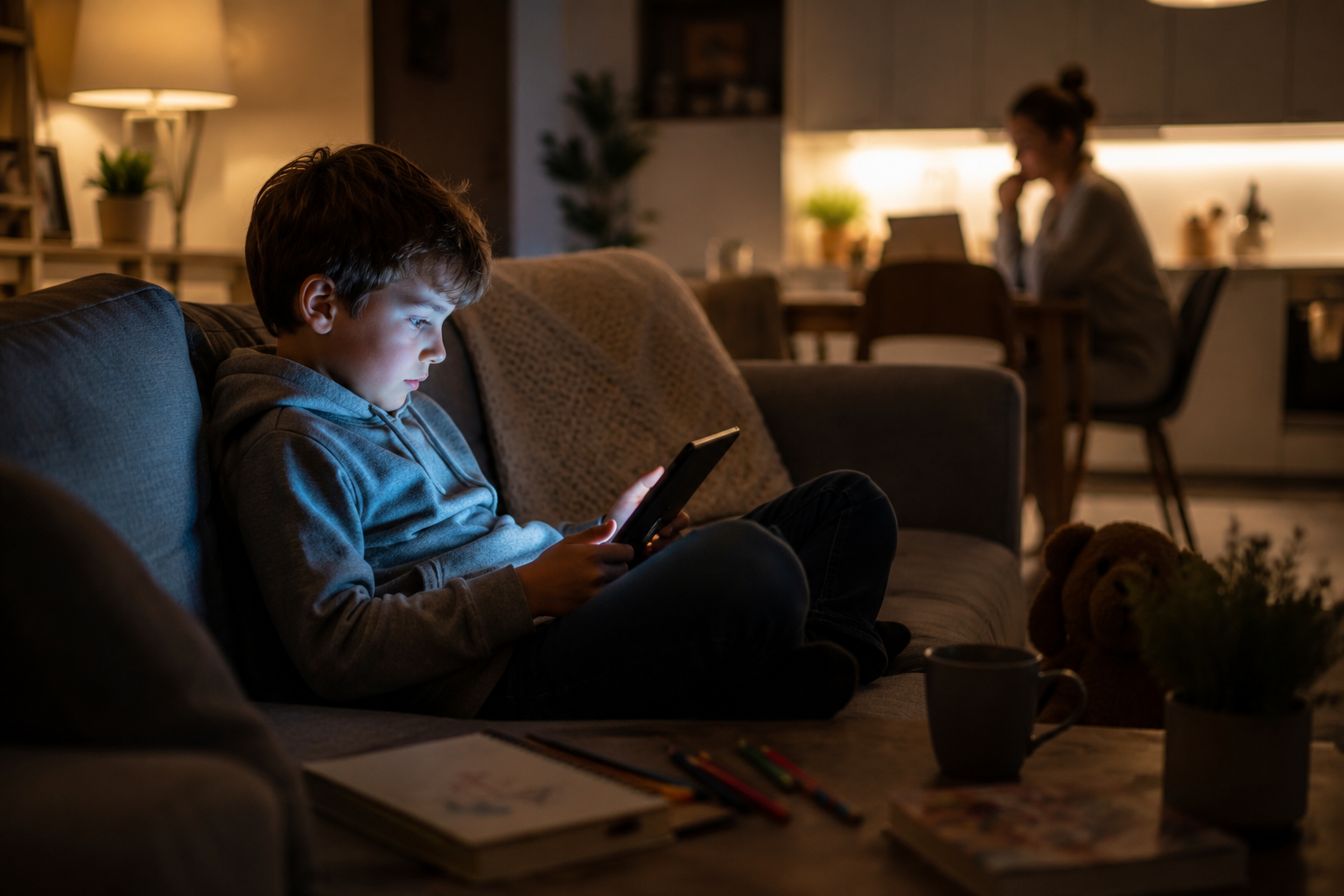
Artificial Co-Regulation: When Technology Becomes Part of Emotional Regulation
Children have always learned emotional regulation through relationships. But what happens when AI, gaming, social media, and digital platforms begin occupying some of that space? This article explores the emerging idea of artificial co-regulation and what it may mean for child development.
One of the most important things children learn during childhood has very little to do with school, sport, or academic achievement.
Long before children learn algebra, grammar, or geography, they are learning something far more fundamental. They are learning how to move through emotional experiences. They are learning what to do when they feel frustrated, disappointed, uncertain, lonely, overwhelmed, anxious, or bored. Much of childhood can be understood as a gradual process of discovering that uncomfortable emotions are not emergencies and that difficult feelings can be experienced, understood, and eventually managed.
For most of human history, this learning has happened through relationships.
A frightened child seeks comfort from a parent. A disappointed child turns to a trusted adult. A nervous child looks for reassurance. A frustrated child borrows calm from somebody whose nervous system is more regulated than their own. Over time, these experiences help children develop the capacity to manage emotions independently, but the process rarely begins there. Before children can regulate themselves, they are often regulated through connection with other people.
Psychologists often describe this process as co-regulation.
Although the term may sound technical, the experience itself is deeply familiar. Most parents have witnessed a distressed child become calmer after being held, listened to, reassured, or simply accompanied through a difficult moment. The child may not have solved the problem, but the presence of another person changes how the problem feels.
What has been occupying my thoughts lately is not co-regulation itself. It is the possibility that technology is beginning to occupy some of the space where co-regulation once occurred almost exclusively through human relationships.
Over the past decade, conversations about technology and children have often focused on content. Are children spending too much time online? Are social media platforms affecting mental health? Are video games becoming too immersive? Are screens replacing physical activity?
These are important questions, but I sometimes wonder whether they cause us to overlook something even more significant.
Perhaps the more interesting question is not what children are consuming, but what they are using technology to accomplish.
A child who watches a video because they enjoy it is doing one thing. A child who instinctively reaches for a screen whenever they feel bored may be doing something different. A child who enjoys speaking with an AI chatbot out of curiosity is engaged in one experience. A child who increasingly turns to an AI system for reassurance, comfort, advice, or emotional support may be engaged in another.
From the outside, the technology looks identical.
The function it serves may be completely different.
This distinction matters because the brain learns from repeated experience. Whatever happens often becomes familiar. Whatever becomes familiar eventually begins to feel normal. Over time, children develop expectations about how emotional discomfort should be handled, how quickly it should disappear, and what kinds of responses are available when difficult feelings arise.
If boredom is consistently followed by stimulation, the brain learns to expect stimulation. If uncertainty is consistently followed by immediate answers, the brain learns to expect certainty. If loneliness is repeatedly relieved through digital interaction, that pattern becomes part of the brain's model of how emotional needs are met.
None of this means technology is inherently harmful. Human brains have always adapted to their environments. The question is not whether adaptation is occurring. The question is what children are adapting to.
One reason I find this particularly interesting is that human relationships and digital systems operate according to very different rules.
Parents cannot provide reassurance every second of every day. Friends are not always available. Teachers cannot immediately solve every problem. Real relationships contain waiting, misunderstanding, disagreement, uncertainty, and repair. They require patience. They require adaptation. They require children to develop the ability to tolerate moments when comfort, answers, or support are not immediately available.
Technology often operates according to an entirely different model.
Algorithms respond instantly. Notifications arrive instantly. Content appears instantly. AI systems provide immediate responses regardless of the time of day. Many digital environments are designed specifically to reduce friction, eliminate waiting, and maintain engagement.
There are obvious advantages to this. Most adults appreciate convenience when it serves us.
At the same time, I find myself wondering whether there are aspects of emotional development that depend on experiences technology is becoming increasingly effective at removing.
Historically, children encountered countless opportunities to practice emotional regulation in ordinary life. They waited their turn. They experienced boredom. They navigated disagreements with friends. They struggled through difficult tasks. They felt disappointed when things did not go their way. Parents and caregivers offered support, but they could not eliminate every uncomfortable feeling. Children gradually developed the ability to tolerate more of these experiences on their own.
That process has never been particularly comfortable, but discomfort has often been one of its most important ingredients.
The possibility that some children may increasingly rely on technology to reduce emotional discomfort raises questions that feel genuinely new. Not because children have never used tools to manage emotions, but because the tools themselves are becoming more responsive, more personalized, and more emotionally sophisticated.
This becomes especially relevant as AI systems continue moving into everyday life.
Recent reports suggest that many young people already use AI chatbots to ask personal questions, seek advice, discuss emotional challenges, and process experiences they might previously have brought to parents, friends, teachers, or other trusted adults. Whether this trend ultimately proves beneficial, harmful, or somewhere in between remains unclear.
What seems clear is that something important is changing.
For the first time in human history, children have access to systems that are available twenty-four hours a day, respond immediately, never appear impatient, never become tired, and always have something to say.
That is a remarkable development.
The mistake may be assuming that this is simply another screen-time discussion. It feels larger than that. What may be emerging is an entirely new category of relationship between children and technology, one that extends beyond entertainment and information into areas that have traditionally belonged to human connection.
A child who reaches for a device to pass the time is engaged in one kind of interaction. A child who increasingly depends on a device to feel calmer, less lonely, less uncertain, or more emotionally secure may be engaged in something fundamentally different.
The distinction is subtle, but I suspect it matters.
As parents, educators, and professionals, we may need to become more curious about the emotional functions technology serves. Conversations about screen time, while still important, may eventually feel incomplete if they ignore the reasons children are turning to these technologies in the first place.
Because the future question may not be how much technology children use.
The future question may be who—or what—they are learning to rely on when life feels difficult.
I've been thinking about that lately.
Frequently Asked Questions
What is co-regulation in child development?
Co-regulation is the process through which children learn to manage emotions with the support of trusted adults. Before children can consistently regulate emotions independently, they often rely on parents, caregivers, teachers, and other supportive relationships to help them navigate stress, frustration, fear, disappointment, and uncertainty.
What is artificial co-regulation?
Artificial co-regulation describes situations where digital technologies such as AI chatbots, social media platforms, gaming environments, or other interactive systems begin serving emotional functions that were traditionally provided through human relationships. This may include providing reassurance, comfort, distraction, advice, or emotional support.
Can technology become part of emotional regulation?
Yes. Technology can sometimes help children manage boredom, loneliness, frustration, anxiety, or uncertainty. The concern is not occasional use, but whether technology gradually becomes a child's primary response to emotional discomfort rather than one tool among many.
Are AI companions harmful for children?
Not necessarily. Researchers are still learning how AI companions may influence development. The more important question is how they are being used and whether they complement healthy relationships or begin replacing opportunities for real-world connection, co-regulation, and emotional growth.
How does dopamine relate to technology and emotional regulation?
Dopamine plays an important role in attention, learning, motivation, and reward prediction. Technologies that provide immediate feedback, novelty, personalization, and stimulation can strongly engage these systems, influencing how children learn to respond to boredom, uncertainty, and other emotional states.
Should parents be concerned if their child talks to AI?
Curiosity is usually more productive than panic. Understanding why a child is turning to AI, what needs it is meeting, and whether it is supplementing or replacing human connection can provide far more useful information than focusing on the technology alone.
This article is part of a broader framework I’m building at Hope For Families around dopamine, motivation, emotional regulation, resilience, nervous system regulation, and the environments that shape how children learn, adapt, and grow.
Related topics: artificial co-regulation, emotional regulation in children, AI companions, dopamine and motivation, nervous system regulation, technology and child development, resilience, screen time, boredom, attachment, and child development.
Why More Children Seem Afraid To Be Bad At Things
Many children seem to decide remarkably quickly whether they are good at something. This article explores what happens when difficulty is mistaken for failure, and why some of the most important learning experiences begin exactly there.
One of the stranger shifts I've noticed over the years is how quickly many children decide whether something is for them.
A child tries football for a few weeks and concludes they aren't athletic. Another struggles with reading and decides they simply aren't a reader. Someone finds mathematics difficult and begins talking as though their relationship with the subject has already been settled. The verdict often arrives surprisingly early, sometimes before the experience has had enough time to become anything at all.
Of course, children have always become frustrated when things felt difficult. There is nothing new about that. Learning has never been a particularly comfortable process, and most children throughout history have experienced moments where they wanted to quit, avoid, or escape from something that felt challenging. What feels different today is not the frustration itself, but how quickly difficulty can become a conclusion about identity.
A child doesn't just think, "This is difficult."
They begin thinking, "Maybe this isn't for me."
I've found myself returning to this idea whenever people talk about motivation. We often describe motivation as though it is supposed to appear first and effort follows afterwards. A child becomes interested, and then they work hard. A child discovers a talent, and then they develop it. A child feels confident, and then they continue.
Yet when I think back to many of the things that eventually became important in my own life, I don't remember them unfolding that way at all.
Most of them began with uncertainty. Some began with boredom. Quite a few began with frustration. Reading wasn't automatically enjoyable. Certain books took time before they drew me in. Learning new skills rarely felt rewarding in the beginning. Even activities I eventually came to love often involved long periods where I wondered whether I was improving at all.
Looking back, that seems obvious. At the time, however, it rarely felt obvious. Progress tends to look much clearer in hindsight than it does while we are living through it.
Part of the problem may be that we are constantly surrounded by finished products. We see talented athletes performing at a high level, musicians who make difficult things look effortless, professionals who appear confident and knowledgeable, and creators whose work seems polished and complete. What remains largely invisible are the years that came before.
We don't see the awkward beginnings.
We don't see the uncertainty.
We don't see the repetition.
We don't see the countless moments where somebody was simply average, confused, inexperienced, or struggling.
Children, however, often compare themselves to the finished version.
That comparison can be surprisingly discouraging because it creates the illusion that competence arrives much faster than it actually does. When a child expects progress to happen quickly, the inevitable difficulties of learning can begin to feel like evidence that something has gone wrong. Yet difficulty has always been part of the process.
In many cases, the experiences we later describe as growth felt remarkably similar to failure while we were living through them. The confusion, the repetition, the mistakes, and the sense of not quite understanding what we were doing are often the very conditions under which learning takes place. What makes them difficult is that they rarely feel productive in the moment. They simply feel difficult.
The more I think about it, the more I wonder whether modern environments sometimes make this reality harder to appreciate.
Increasingly, children grow up surrounded by experiences that provide immediate feedback. Games teach mechanics quickly. Algorithms learn preferences quickly. Answers arrive quickly. Entertainment captures attention quickly. Technology has become remarkably effective at reducing friction, uncertainty, and waiting.
There are obvious benefits to that. Most of us appreciate convenience when it serves us.
At the same time, much of real life still operates according to a very different set of rules.
Relationships deepen slowly. Confidence emerges gradually through accumulated experience rather than a single success. Mastery is usually the result of countless ordinary moments that, taken individually, seem far less impressive than the finished skill they eventually produce. Many of the things that become most meaningful in life require patience long before they become rewarding.
The brain does not always enjoy that arrangement.
One of the more interesting things neuroscience has taught us is that motivation is closely tied to expectation. The brain is constantly evaluating whether effort is likely to be worthwhile. Experiences that feel rewarding encourage us to continue. Experiences that repeatedly feel frustrating encourage us to pull away. This system makes sense because it helps us learn efficiently and directs our attention toward opportunities that appear valuable.
The challenge is that not everything valuable feels rewarding at the beginning.
Some things become rewarding only after we have stayed with them long enough.
A child learning to read may spend months feeling slow and uncertain before books begin to open up. A young athlete may spend years developing skills that improve only gradually. A student learning mathematics may encounter concepts that feel confusing long before they become satisfying. In each case, the reward arrives later than many children expect.
Sometimes much later.
That delay creates an interesting challenge because children are increasingly growing up in environments where rewards often arrive quickly and predictably. When they encounter activities that require patience, repetition, uncertainty, and persistence, those activities can feel unusually demanding by comparison.
From the outside, it can look like a motivation problem.
Parents often describe children who abandon activities quickly, avoid challenges, or lose interest whenever something becomes difficult. The natural response is to ask how we can increase motivation, but I sometimes wonder whether a different question deserves equal attention.
Have children had enough opportunities to experience what it feels like to become good at something slowly?
Not instantly.
Not naturally.
Not effortlessly.
Slowly enough to understand that progress often arrives long after the decision to continue.
Because many of the qualities we admire in adults emerge from exactly that process. Resilience is not developed when everything goes well. Confidence is not built through constant success. Persistence is not created by avoiding difficulty. These qualities grow through repeated experiences of encountering something challenging and discovering that difficulty itself is survivable.
Perhaps one of the most important lessons children can learn is that being bad at something is not evidence that they should stop. It may simply be evidence that they have arrived at the point where learning begins.
That idea feels increasingly important because so much of modern life encourages quick judgments. We decide whether content is worth consuming within seconds. We decide whether a film is interesting within minutes. We decide whether an activity is enjoyable almost immediately. The habit of evaluating experiences quickly can quietly shape how we approach challenges, relationships, learning, and even ourselves.
Yet some of the most valuable parts of life have always demanded a different pace.
Knowledge accumulates slowly. Skills improve slowly. Relationships deepen slowly. Character develops slowly. Even interest itself is often slower than we remember. Many people discover passions not because they felt inspired from the beginning, but because they remained engaged long enough for inspiration to appear.
When I think about the children who eventually become deeply invested in something, whether it is sport, music, reading, science, art, or any other pursuit, I doubt many of them felt passionate from the very beginning. More often, they stayed long enough for interest to emerge, competence to develop, and confidence to follow.
The finished result is easy to admire because it is visible.
What is far easier to overlook is the long period of uncertainty that came before it.
Maybe that is why I keep returning to this idea. In a world that increasingly celebrates immediate outcomes, one of the most valuable skills a child can develop may be the willingness to remain imperfect for longer than feels comfortable.
Not forever.
Just long enough for learning to do its work.
This article is part of a broader framework I’m building at Hope For Families around dopamine, motivation, effort, emotional regulation, resilience, and the environments that shape how children learn, adapt, and grow.
Related topics: motivation in children, effort and learning, resilience, fear of failure, growth mindset, dopamine and motivation, emotional regulation, persistence, boredom, and child development.
Frequently Asked Questions
Why do some children give up so quickly when something feels difficult?
Children often interpret difficulty as a sign that they are not good at something, rather than a normal part of learning. This can make them more likely to avoid challenges before competence has had time to develop.
Can low motivation actually be a fear of failure?
Sometimes. What appears to be low motivation may actually reflect a child's reluctance to engage in activities where success is uncertain or where mistakes feel uncomfortable.
What role does dopamine play in effort and motivation?
Dopamine helps the brain evaluate whether effort is likely to be worthwhile. It plays an important role in motivation, learning, persistence, and reward prediction.
How can parents help children develop resilience?
Resilience often develops through repeated experiences of facing manageable challenges, making mistakes, and discovering that difficulty can be overcome rather than avoided.

Why Some Children Struggle to Feel Interested in Ordinary Life
Many children seem to become bored faster than they once did. This article explores whether the issue is really motivation—or whether modern environments are changing how interest develops in the first place.
A few weeks ago, one of my boys wandered through the living room looking for something to do. There were books on the shelf, building blocks scattered across the floor, a football by the door, and several toys that had held his attention perfectly well only a few days earlier. He glanced around for a moment, considered his options, and then announced that he was bored.
There was nothing particularly unusual about that. Children have always complained about being bored. What caught my attention was something else. The whole process seemed remarkably quick, almost as if the decision had been made before he had really looked. Within a few seconds he had surveyed the room, dismissed everything in it, and concluded that there was nothing available worth doing.
Since then, I've started noticing similar moments elsewhere. A child comes home from football practice and immediately starts looking for the next thing. A family spends the afternoon swimming, cycling, or visiting friends, only to hear complaints about boredom shortly after returning home. Even adults seem increasingly uncomfortable with empty spaces in the day. We stand in line, wait for appointments, sit at traffic lights, and instinctively reach for something to fill the gap.
None of this feels particularly dramatic. In fact, it feels so ordinary that most of us hardly notice it. Yet the more I pay attention to these small moments, the more I find myself wondering whether something subtle has changed in the relationship many of us have with boredom, waiting, and interest itself.
When I think back to my own childhood, I don't remember boredom as being enjoyable. I remember long car journeys, rainy afternoons, and endless periods where nothing especially interesting seemed to be happening. But I also remember that boredom often lasted long enough for something else to emerge. A game would gradually take shape. Somebody would come up with an idea. What began as restlessness slowly turned into curiosity, and curiosity eventually became engagement.
The interesting part rarely arrived immediately. More often, it appeared somewhere on the other side of waiting.
Lately I've found myself wondering whether children are getting fewer opportunities to experience that process. Not because they are less creative or less capable than previous generations, but because so many experiences now arrive fully formed. Entertainment arrives ready-made. Distraction is available almost instantly. Moments that once required us to sit with boredom for a while can now be filled within seconds.
I've been thinking about that lately.
One of the assumptions we often make about motivation is that it comes first. We imagine that people become interested in something and then decide to pursue it. We feel motivated, so we begin. We feel curious, so we pay attention. We feel inspired, so we put in the effort.
But when I look back at many of the things that became important to me, I don't remember them working that way.
Reading wasn't immediately interesting. Some books took time before they pulled me in. Learning a skill wasn't immediately rewarding. Friendships weren't built in a single afternoon. Even many childhood games started with a group of kids standing around saying there was nothing to do before somebody suggested an idea and everyone gradually became absorbed in it.
The motivation often came after the beginning, not before it.
That seems worth paying attention to because much of modern life works in the opposite direction. Increasingly, we are surrounded by experiences that are designed to capture attention immediately. If something fails to engage us within a few seconds, there is almost always something else available. Another video. Another notification. Another recommendation. Another source of stimulation waiting nearby.
This is not simply a conversation about screens. It is easy to reduce it to that, but I think the issue runs deeper. Screens are only one expression of a much larger shift. The broader change is that we now live in environments where the gap between boredom and stimulation has become remarkably small.
For most of human history, boredom was difficult to escape. If you were waiting, you waited. If you were bored, you remained bored for a while. If nothing interesting was happening, there was often no immediate solution available. Eventually the mind started doing what minds have always done. It wandered. It explored. It searched. Sometimes it invented something.
Today the search often ends before it begins. That may sound like a small change, but I wonder whether it alters something important in how children learn to engage with the world around them.
The brain is constantly learning what to expect. Not through lectures or instructions, but through repeated experience. Whatever happens often begins to feel normal. Whatever feels normal eventually becomes expected.
If interest regularly arrives instantly, what happens when a child encounters something that unfolds slowly?
What happens when learning requires repetition before it becomes rewarding?
What happens when a hobby feels awkward before it feels enjoyable?
What happens when a conversation takes time to become interesting?
These are not hypothetical questions. They are woven into everyday family life. Parents describe children who abandon activities quickly, move rapidly between sources of stimulation, or complain that everything feels boring despite having access to more entertainment than previous generations could have imagined.
From the outside, it can look like a motivation problem. Sometimes it may be. But sometimes I wonder whether it is something slightly different.
Perhaps what we are seeing is not a loss of interest, but a reduced tolerance for the period that often comes before interest emerges. That possibility has become increasingly difficult for me to ignore.
When people talk about dopamine, the conversation often becomes overly simplistic. Dopamine is frequently described as a pleasure chemical, but the reality is far more interesting. Dopamine plays an important role in learning, attention, anticipation, and motivation. It helps the brain determine what is worth paying attention to and what experiences should be repeated.
The important thing is that these systems learn from experience.
The environment matters.
Repetition matters.
What captures attention repeatedly begins to shape future expectations.
This doesn't mean children are broken. It doesn't mean technology is inherently harmful. It certainly doesn't mean we should romanticize previous generations.
It simply means that brains adapt.
They always have.
The question is what they are adapting to.
Many of the parents I speak with are not worried because their children lack intelligence or potential. They are worried because ordinary life sometimes seems to struggle to compete. Reading feels difficult. Practicing skills feels difficult. Chores feel difficult. Even play occasionally feels difficult unless something highly stimulating is involved.
What makes this so confusing is that the same child who appears completely uninterested one moment can become intensely focused the next. That contrast often leaves parents wondering what happened to their motivation.
Perhaps motivation is not disappearing.
Perhaps it is being trained.
Perhaps the brain is simply learning, as brains always do, from the environments it experiences most often.
I don't think the goal is to eliminate boredom. In fact, I suspect boredom was never the real problem.
The more I think about it, the more I find myself wondering whether boredom may be one of the few remaining spaces where something unexpected can still happen. It sits between activities, between plans, between sources of entertainment. It feels uncomfortable enough that most of us try to escape it, yet it has often been the starting point for imagination, curiosity, creativity, exploration, and self-directed play.
Maybe the question isn't why some children seem less interested in ordinary life.
Maybe the question is how often ordinary life gets the chance to become interesting before something else takes its place.
Children Were Never Meant for This Much Stimulation
Many children today seem restless, easily bored, emotionally overwhelmed, or less motivated than parents expect. This article explores how overstimulation, dopamine, and nervous system regulation may be shaping modern childhood.
Quick Summary
Many parents worry when a child seems unmotivated, constantly bored, emotionally reactive, or unable to focus on everyday activities.
In many cases, the issue is not laziness or a lack of discipline.
Children's motivation, attention, and emotional regulation are influenced by brain development, stress, sleep, environment, relationships, and the amount of stimulation they experience each day.
Understanding how dopamine, overstimulation, and nervous system regulation interact can help parents create conditions that support healthier motivation, resilience, and long-term wellbeing.
A few weeks ago, I watched my son move from one form of stimulation to another.
Not because he was excited.
Not because he was deeply interested in what he was doing.
More because he seemed unable to settle anywhere for very long.
A short video.
Then another.
Then a game.
Then boredom.
Then searching for something else.
And standing there, I found myself wondering about something I hear more and more parents talk about.
Why do so many children seem restless, easily bored, and less motivated than they used to be?
Not all children.
Not all the time.
But often enough that parents, teachers, and researchers are beginning to ask the same question.
Maybe the issue is not motivation at all.
Maybe it is stimulation.
Children Are Growing Up Inside Constant Stimulation
Sometimes I wonder if adults have slowly become so used to constant stimulation that we no longer notice how unusual it actually is.
Notifications.
Videos.
Background television.
Music.
Games.
Scrolling.
Multiple screens.
Information arriving every minute of the day.
Then we look at children who struggle with attention, emotional regulation, boredom, or frustration and ask:
"What is wrong with them?"
But perhaps a better question is:
What kind of nervous system could realistically stay regulated inside environments like this?
Many children today are not growing up inside calm environments.
They are growing up inside constant activation.
And the brain adapts to whatever environment it spends the most time in.
That is one of the most important principles in neuroscience.
The brain is always learning:
What should I pay attention to?
How much stimulation is normal?
How quickly should rewards arrive?
How much discomfort should I tolerate?
What should I do when I feel bored?
Children do not consciously choose these patterns.
Their brains learn them through repeated experience.
Motivation Is Not A Personality Trait
One of the biggest misunderstandings about motivation is the belief that some children naturally have it and others simply do not.
Motivation is constantly changing.
It is influenced by:
Sleep
Stress
Relationships
Physical activity
Emotional regulation
Novelty
Environment
Expectations
Learning experiences
A child who appears highly motivated in one situation may seem completely uninterested in another.
That does not necessarily mean something is wrong.
Often it means the brain has learned that one activity feels rewarding while another does not. This is one reason many parents wonder why kids avoid effort, even when they are capable of completing the task.
Understanding motivation in children requires looking beyond behavior and asking what experiences are shaping the brain underneath it.
The Role Of Dopamine
Dopamine is often described as the brain's reward chemical.
But that description is incomplete.
Dopamine is deeply involved in motivation, anticipation, learning, attention, and goal-directed behavior.
In simple terms, dopamine helps the brain decide what is worth pursuing.
When children experience challenge, movement, social connection, achievement, play, and learning, dopamine helps reinforce those experiences.
The brain begins learning:
"This is worth doing again." This may also help explain why rewards stop working in children over time when stimulation becomes excessive or expected.
Over time, repeated experiences shape motivation. You can read more about this in our guide to Dopamine & Motivation.
The brain adapts to what it repeatedly encounters.
That is true whether those experiences involve healthy challenges, meaningful relationships, sports, learning, or constant digital stimulation.
Why Boredom Matters More Than We Think
Many parents see boredom as something to eliminate.
Historically, boredom often served a different purpose.
Boredom created a gap.
And inside that gap, children created something.
Games.
Stories.
Ideas.
Questions.
Imagination.
Problem-solving.
Today, boredom often lasts only seconds before a screen provides an answer.
The brain no longer has to generate engagement because engagement arrives automatically.
Over time, children may have fewer opportunities to practice creating their own interest and motivation.
The answer arrives before the search ever begins.
Overstimulation And The Nervous System
One of the most important conversations happening right now involves nervous system regulation.
Increasingly, parents, educators, and clinicians are moving away from asking:
"What is wrong with this child's behavior?"
And toward asking:
"What state is this child's nervous system in?"
That shift matters.
Because behavior often reflects nervous system state. This is closely connected to what researchers call emotional regulation in children.
An overwhelmed nervous system does not learn, regulate emotions, tolerate frustration, or access motivation the same way a regulated nervous system does.
Overstimulation can look like:
Low motivation
Emotional outbursts
Irritability
Restlessness
Avoidance
Difficulty focusing
Trouble transitioning between activities
Low frustration tolerance
Constant stimulation-seeking
Many of these behaviors are often interpreted as attitude problems.
Sometimes they are actually signs of overload.
Screens, Stimulation, And Modern Childhood
This does not mean screens are bad.
Technology provides many benefits.
The challenge is that children are growing up in environments that provide more stimulation than any generation before them has experienced.
Short videos.
Infinite scrolling.
Notifications.
Algorithms designed to capture attention.
Constant novelty.
Fast rewards.
Compared to these experiences, everyday life can feel slower.
Reading feels slower.
Homework feels slower.
Learning new skills feels slower.
Conversations feel slower.
Even play can feel slower.
Children are not broken.
The brain is simply adapting to the environment around it. We explore this relationship further in Dopamine & Screen Time.
The question is whether that environment is helping develop the skills children need for long-term wellbeing.
Why Emotional Safety And Co-Regulation Matter
Children do not learn emotional regulation alone.
They learn it through relationships.
Before children can consistently regulate themselves, they often rely on adults to help regulate them.
This process is called co-regulation.
A calm adult nervous system can help stabilize a stressed child nervous system.
Not instantly.
Not perfectly.
But repeatedly.
And repetition matters.
Because repeated experiences shape brain development.
Children learn safety through repeated experiences of safety.
Children learn regulation through repeated experiences of regulation.
The nervous system develops through experience long before it develops through instruction.
What Parents Can Do
There is no perfect formula.
Every child is different.
But several principles consistently support healthy motivation and nervous system regulation.
Protect Sleep
Sleep affects attention, learning, emotional regulation, stress recovery, and motivation.
Few interventions are more powerful.
Make Room For Boredom
Not every moment requires entertainment.
Unstructured time allows children to create, imagine, explore, and discover interests of their own.
Prioritize Movement
Physical activity supports emotional regulation, attention, stress management, and motivation.
Children were designed to move.
Focus On Connection
Children are more likely to engage when they feel safe, understood, and connected.
Relationship often comes before motivation.
Reduce Overload
Sometimes the solution is not adding another reward.
Sometimes the solution is reducing the amount of stimulation competing for attention.
The Bigger Question
When parents ask:
"Why is my child unmotivated?"
the answer is rarely simple.
Motivation is not something children either possess or lack. Understanding the early signs of low motivation in children can help parents identify problems before they become larger challenges.
It develops within an environment.
Perhaps the better question is:
"What experiences is my child's brain learning from every day?"
Because over time, those experiences shape:
What feels rewarding.
What feels interesting.
What feels worth the effort.
And ultimately, who children become.
This is part of a broader framework I’m building at Hope For Families around dopamine, motivation, emotional regulation, nervous system regulation, and early risk patterns in children.
Related topics: dopamine and motivation, emotional regulation in children, screen time and dopamine, low motivation in children, nervous system regulation, overstimulation, boredom, effort, and early risk patterns.
Frequently Asked Questions
Why does my child seem unmotivated?
Children may appear unmotivated when they are tired, stressed, emotionally overwhelmed, overstimulated, or disconnected from activities that feel meaningful and rewarding.
Can too much screen time affect motivation?
For some children, excessive screen use may make slower everyday activities feel less rewarding because screens provide constant novelty, stimulation, and immediate feedback.
Is boredom healthy for children?
Yes. Boredom can help children develop creativity, imagination, problem-solving skills, independence, and self-directed play.
What role does dopamine play in motivation?
Dopamine helps the brain learn what is worth paying attention to and pursuing. It plays an important role in motivation, learning, attention, and goal-directed behavior.
What is nervous system regulation?
Nervous system regulation refers to the body's ability to manage stress, emotions, attention, and arousal levels. Children often rely on supportive adults to help develop these abilities over time.
Can overstimulation affect emotional regulation?
Yes. Constant stimulation can make it harder for some children to tolerate boredom, frustration, transitions, and everyday challenges.
How can parents support healthy motivation?
Parents can support healthy motivation by prioritizing sleep, movement, emotional connection, opportunities for boredom, manageable challenges, and balanced screen use.
Children Were Never Meant for This Much Stimulation
Sometimes I wonder if adults have slowly become so used to constant stimulation that we no longer notice how unnatural it actually is.
Noise all the time.
Notifications.
Videos.
Background TV.
Bright screens.
Fast cuts.
Constant talking.
Constant information.
Music in the car.
Music in the store.
Music while eating.
Music while scrolling.
And then we look at children who cannot sit still, cannot focus, cannot regulate themselves emotionally, and we ask:
“What’s wrong with them?”
But honestly…
sometimes I think the better question is:
What kind of nervous system could realistically stay regulated inside environments like this?
Because many children today are not growing up inside calm nervous systems.
They are growing up inside constant activation.
And the brain adapts to whatever environment it spends the most time in.
That part matters more than people realize.
The brain is always learning:
What should I pay attention to?
What level of stimulation is “normal”?
How much silence should I tolerate?
How fast should reward arrive?
How much discomfort should I expect before escape is available?
Children do not consciously choose these patterns.
Their nervous systems absorb them.
Over time, this can start showing up in ways adults often misunderstand.
A child who cannot tolerate boredom.
A child who needs constant input.
A child who melts down over seemingly small things.
A child who says everything feels “boring.”
A child who struggles to transition from stimulation to slower tasks like homework, sleep, reading, conversation, or emotional regulation.
And unfortunately, many adults interpret this as attitude, laziness, defiance, or lack of discipline.
But a nervous system that has adapted to high stimulation often experiences ordinary life very differently.
Quiet can feel uncomfortable.
Stillness can feel stressful.
Slower rewards can feel emotionally flat.
Even normal daily tasks can start feeling under-stimulating compared to the speed and intensity the brain has become used to.
This is one reason dopamine conversations have become so important recently.
Not because dopamine is “bad.”
But because dopamine helps shape attention, motivation, reward prediction, novelty-seeking, and learning.
The brain pays attention to what feels stimulating, emotionally rewarding, fast, unpredictable, or relieving.
And modern environments have become extremely good at capturing those systems.
Especially for developing brains.
Children today are growing up surrounded by platforms, apps, algorithms, and digital environments specifically engineered to hold attention for as long as possible.
Short videos.
Fast edits.
Endless scrolling.
Constant novelty.
Rapid emotional shifts.
Tiny bursts of reward over and over again.
The developing brain adapts to repetition.
That is what brains do.
And honestly, I think many adults can feel this happening to themselves too.
A lot of people now quietly admit things like:
“I can’t focus like I used to.”
“I feel restless all the time.”
“Everything feels boring unless it’s stimulating.”
“My brain feels fried.”
That should probably tell us something.
Because this conversation is no longer just about children.
It is about nervous systems in general.
One of the biggest cultural shifts happening right now is that more people are starting to look underneath behavior instead of only reacting to behavior itself.
Less:
“What’s wrong with this child?”
More:
“What state is this nervous system in?”
That shift matters enormously.
Because behavior changes depending on stress state.
An overwhelmed nervous system does not learn, feel, regulate, process frustration, or access motivation the same way as a regulated one.
And many children are spending large portions of the day either overstimulated, emotionally overloaded, dysregulated, or mentally exhausted without adults fully recognizing it.
Sometimes the signs are obvious.
Sometimes they are not.
Overstimulation does not always look chaotic.
Sometimes it looks like emotional shutdown.
Avoidance.
Irritability.
Constant stimulation-seeking.
Low frustration tolerance.
Difficulty transitioning.
Trouble sleeping.
Needing noise constantly.
Or seeming emotionally “flat” unless something highly stimulating is happening.
And I think this is where co-regulation becomes incredibly important.
Children borrow calm from adults long before they can consistently create it internally themselves.
A regulated adult nervous system can help stabilize a dysregulated child nervous system.
Not perfectly.
Not instantly.
But repeatedly.
And repetition matters because repeated experiences shape wiring.
That is one of the most important things neuroscience teaches us.
The brain changes according to repeated experience.
Not occasional insight.
Not lectures.
Not punishment alone.
Experience.
Repetition.
Environment.
Stress patterns.
Relational safety.
Emotional predictability.
This does not mean screens are evil.
It does not mean stimulation is bad.
It does not mean children should never use technology.
That conversation becomes too simplistic.
The real question is probably this:
Has the nervous system been given enough opportunities to experience the opposite too?
Silence.
Slowness.
Boredom.
Recovery.
Human connection.
Predictability.
Movement.
Rest.
Conversation.
Unstructured play.
Emotional safety.
Because children were never meant to live inside nonstop stimulation without recovery.
Honestly, I do not think adult nervous systems were either.
Why Some Kids Seem Fine Until They’re Overwhelmed
What stress, dopamine, and emotional overload can look like in everyday life.
A lot of children seem completely fine…
Until suddenly they’re not.
A small correction turns into a meltdown.
Homework becomes impossible.
A normal morning spirals fast.
And as adults, it can feel confusing because nothing “big” actually happened.
But often, the problem isn’t the moment itself.
It’s the buildup underneath it.
Stress Doesn’t Always Look Like Stress
One of the biggest misunderstandings around children is that stress always looks obvious.
Sometimes it looks like:
Avoidance.
Shutting down.
Irritability.
Constant stimulation-seeking.
Needing noise all the time.
Or struggling with even small amounts of discomfort.
A child can look “fine” for a long time while their nervous system is overloaded.
The Brain Adapts to Pressure
Children’s brains are constantly adapting to the environments around them.
Fast stimulation.
Constant input.
Little recovery.
High emotional intensity.
Over time, the brain can begin to expect a state of constant activation.
And when that happens, small challenges start feeling much bigger.
This Is Where Dopamine Matters
This is also closely connected to how modern digital environments shape motivation and emotional regulation in children → see how screen time affects motivation and behavior
Most people think dopamine is only about pleasure or reward.
But dopamine is also deeply connected to attention, stress, motivation, and what the brain learns to move toward under pressure.
When the brain becomes overloaded, it naturally starts searching for:
Quick relief.
Fast distraction.
Easy escape.
Not because the child is weak.
Because the brain is trying to regulate itself.
Why “Overreacting” Usually Misses the Point
When children become emotionally overwhelmed, adults often focus only on the reaction itself.
“Calm down.”
“It’s not a big deal.”
“You’re overreacting.”
But emotional overload is usually the result of accumulated strain — not just the situation in front of them.
The reaction is often the visible part.
Not the beginning.
What Actually Helps
Children usually regulate better when life becomes more predictable, slower, and emotionally safer.
Not perfect.
Just less overwhelming.
That can mean:
More recovery time.
Less constant stimulation.
More structure.
More boredom.
More repetition.
Less emotional chaos around them.
Small nervous systems need rhythm more than intensity.
A Different Way to Look at Behavior
Sometimes behavior is not really about the behavior.
Sometimes it’s about how overloaded the system underneath has become.
And once you start seeing that…
a lot of children suddenly make more sense.
To understand how dopamine shapes motivation, stress, and behavior in children, you can explore the full framework here
Why Kids Delay Starting Tasks (And What It Actually Means)
Why It Often Starts With “I’ll Do It Later”
Not refusal.
Not avoidance in a clear way.
Just a small delay.
---
You ask your child to do something simple.
Homework. Getting ready. Cleaning up.
And they say they will.
Just not right now.
---
“I’ll do it later.”
---
At first, it doesn’t stand out.
It sounds reasonable.
Even cooperative.
They’re not saying no.
They’re not pushing back.
So it’s easy to let it pass.
---
But when you look at it over time, something starts to feel a bit off.
Because “later” keeps moving.
And the starting point keeps getting pushed further away.
---
I’ve heard parents describe this in a lot of different ways.
“Everything takes longer.”
“I have to remind them more.”
“It’s like they’re always just about to start… but don’t.”
---
And it’s easy to think this is about responsibility.
Or habits.
Or just needing a bit more structure.
---
But when you stay with it a bit longer, it doesn’t quite line up.
Because the child usually knows what to do.
And often wants to do it.
---
It’s the starting that feels different.
---
I catch myself thinking about that part more now.
What does it actually feel like to begin something?
Because it’s not neutral.
---
Some things you just start.
Without much friction.
You don’t think about it.
You move toward it.
---
Other things feel like they sit just outside reach.
You circle around them.
You delay.
You tell yourself you’ll get to it.
---
Even when you know you should.
---
I don’t think that difference is random.
---
If a child spends a lot of time in environments where things are:
fast
responsive
always giving something back
…it doesn’t take long before that becomes what their system expects.
---
Not something they think about.
Just something that feels normal.
---
So when something slower shows up…
something that requires a bit of patience
or staying with one thing for a while
…it doesn’t just feel boring.
---
It can feel like there’s nothing there to hold onto.
---
From the outside, that looks like procrastination.
From the inside, it might feel more like:
“I’m not getting pulled into this at all.”
---
That’s a different kind of problem.
---
Dopamine gets talked about a lot here, usually as motivation or reward.
I don’t really think about it like that anymore.
---
More like direction.
---
What the brain starts moving toward, based on what it has learned to respond to over time.
---
So if certain types of experiences keep standing out…
the brain leans in that direction.
---
And other things, by comparison, don’t.
---
You don’t notice it in one moment.
But over time, something small starts to build.
---
Not resistance.
Not defiance.
---
Just a growing gap between:
knowing something needs to be done
and actually starting it
---
And that’s usually where more pressure comes in.
More reminders.
More structure.
Trying to close that gap.
---
Sometimes it works.
For a bit.
---
But it doesn’t really change how it feels to begin.
---
I keep coming back to a slightly different question now.
Not “why won’t they just start”
but
“what has their brain learned to move toward first”
---
And maybe just as much:
what no longer feels worth starting
and when that changed
---
If you want to understand how dopamine shapes motivation and behavior in children, you can explore the full framework here:
https://www.hope-4-families.com
---
This is part of a broader framework I’m building at Hope For Families around dopamine, motivation, and early risk patterns in children.
About the author
Patrick Dahlstrom is the founder of Hope For Families, a neuroscience-informed platform focused on dopamine, motivation, and early patterns in children.
Why Kids Avoid Effort
Not because they’re lazy — but because something has changed in how effort feels.
It shows up in small ways.
Homework that used to be manageable suddenly feels like too much.
Simple things turn into pushback.
Things that don’t look that hard… somehow feel heavy.
And it’s easy to go straight to motivation.
Or discipline.
Or just think, “they don’t want to try”
But when you stay with it a bit longer, it doesn’t quite line up.
Because most kids aren’t avoiding everything.
They’ll spend energy on certain things without any problem at all.
It’s just… not the things we expect.
That part keeps coming back for me.
Not that effort disappears.
But that it shifts.
I catch myself thinking about this from the inside instead.
What does effort actually feel like?
Because it doesn’t feel the same across everything.
Some things you just start.
Other things… you sort of hover around.
And I don’t think that’s random.
If a child spends a lot of time in environments where things are fast, engaging, constantly changing…
it doesn’t take that long before that becomes normal.
Not something they think about. Just what their system gets used to.
So when something slower shows up…
something that requires a bit of patience, or staying with one thing…
it’s not just “boring”.
It’s almost like it doesn’t register the same way.
Flat is probably closer.
Or just harder to get into, even if it shouldn’t be.
From the outside that looks like avoidance.
From the inside it might feel more like:
“this isn’t pulling me in at all”
Which is a different kind of problem.
Dopamine gets talked about a lot here, usually as motivation or reward.
I don’t really think about it like that anymore.
More like direction.
What the brain starts moving toward, based on what it has learned to respond to.
So if certain types of input keep standing out…
the brain starts to lean in that direction.
And other things, by comparison, just don’t have the same pull.
That difference seems to grow over time.
You don’t notice it in one moment.
But suddenly effort isn’t neutral anymore.
Some things feel easy to start.
Other things feel like you have to push yourself just to begin.
And that’s usually where more pressure comes in.
More reminders.
More structure.
Sometimes more reward again.
Trying to get movement where there isn’t much.
And sometimes that works, for a bit.
But it doesn’t really change how it feels to do the thing.
I keep coming back to a slightly different question now.
Not “how do we get them to try more”
but
“what has their brain learned to move toward”
And maybe just as much:
what doesn’t feel worth it anymore
and when that started
If you want to go deeper into how dopamine shapes motivation and behavior in children, you can explore the full framework here:
https://www.hope-4-families.com
This is part of a broader framework I’m building at Hope For Families around dopamine, motivation, and early patterns in children.
Why Rewards Stop Working in Children: A Neuroscience Perspective on Motivation
A lot of parents end up trying the same thing at some point.
Rewards.
It usually starts pretty simply.
“If you finish your homework, you get this.”
“If you do your chores, you can have that.”
And it does work. That’s the tricky part.
You see it right away. Things move faster, less resistance, fewer arguments. It feels like you found something that helps.
But then, over time… something shifts.
Not all at once. It’s more gradual than that.
You notice you have to remind a bit more.
Maybe repeat yourself.
Maybe increase it slightly just to get the same response.
And after a while it’s not really doing what it did in the beginning.
That part tends to be frustrating, because it doesn’t make much sense on the surface.
I don’t think this is really about motivation in the way we usually think about it.
It looks like motivation, but it behaves more like adaptation.
Because when something works over and over in the same way, the brain doesn’t just keep responding the same.
It adjusts.
And once it adjusts, the whole thing starts to feel different from the inside.
Motivation isn’t something a child either has or doesn’t have.
It’s something that gets shaped, quietly, through repetition.
So if the same pattern keeps showing up — same task, same reward, same outcome — the brain starts to recognize it as familiar.
And familiar things don’t stand out in the same way.
That’s where dopamine gets misunderstood a lot.
Not as a “reward chemical”, but more like a signal for what matters… or what stands out compared to before.
Something new, or slightly different, tends to get a stronger response.
Something expected… not so much.
So if a child keeps experiencing:
the same reward
for the same behavior
in the same way
the brain doesn’t stay excited about it.
It just learns it.
And that’s often the moment where things start to feel heavier.
More effort from the parent side.
Less response from the child.
What I see quite often then is that the reward gets adjusted.
A bit bigger.
A bit more.
Trying to bring back what used to work.
Which makes sense when you’re in it.
But it also keeps the same pattern going:
“I do this → I get something”
And not so much:
“This is worth doing”
And that difference is small on the surface, but it builds over time.
Because if everything is tied to getting something back, the brain doesn’t really get much practice in noticing effort, or finishing something just because it’s done.
That part sort of… stays underdeveloped.
This isn’t really about removing rewards completely either.
That usually isn’t realistic.
It’s more about how predictable they become, and what the brain starts to expect from them.
This is often where we see the shift toward a deeper reluctance—see why kids avoid effort and what drives it.
Sometimes just changing the pattern a bit shifts things.
Not every effort needing the same response.
Not every action tied to the same outcome.
Even just bringing attention to what was actually done, instead of what comes after it, can feel different.
I catch myself thinking about this sometimes in a slightly different way.
Not “why isn’t this working anymore”
but more
“what has the brain gotten used to here”
Because it rarely stops working randomly.
It usually stops working because something has been learned.
And once something has been learned in a certain way…
it doesn’t really go back on its own.
f you want to understand the foundation of how dopamine shapes motivation and behavior in children, I’ve put together a full framework here."
Why “This Is Boring” Is Becoming the Default in Kids (And What It Actually Means)
Most parents notice it at some point:
“This is boring.”
Homework.
Reading.
Practice.
Even activities your child used to enjoy.
At first, it seems small.
But over time, it starts to feel like everything that requires effort is met with resistance.
It’s easy to think:
👉 “They just don’t want to try.”
👉 “They need more discipline.”
But that’s not what’s actually happening.
To understand this more deeply, see how dopamine shapes motivation and behavior in children.
This Isn’t About Boredom—It’s About the Brain
When a child says “this is boring,”
they’re not just describing the activity.
They’re describing how their brain is responding to it.
👉 A signal about what feels worth moving toward.
And that signal is shaped by one system:
Dopamine.
Dopamine Doesn’t Measure Fun—It Measures Direction
Dopamine is often misunderstood as a “pleasure chemical.”
But in reality:
👉 It answers one question:
“What should I move toward next?”
And the answer is based on experience.
Not logic.
Not intention.
Learning.
The Brain Is Adapting to a Different Baseline
Every day, children are exposed to:
Fast stimulation
Instant rewards
Constant novelty
This trains the brain to expect:
👉 Easy → fast → engaging
So when something doesn’t match that pattern:
Homework
Reading
Practicing
Repetition
…it doesn’t just feel boring.
👉 It feels like the wrong direction.
So “This Is Boring” Is Actually This:
👉 “My brain is not signaling this as worth doing.”
That’s a completely different problem.
And it requires a completely different response.
Why Trying to “Make It Fun” Often Fails
A common reaction is to make everything more engaging.
More stimulation.
More rewards.
More excitement.
But this often backfires.
👉 Because it strengthens the same pattern:
“Only high stimulation is worth doing.”
And the gap between real life and expectation gets bigger.
The Pattern That Builds Over Time
If the brain repeatedly learns:
Fast relief
High stimulation
Low effort reward
It begins to avoid:
Effort
Delay
Discomfort
This doesn’t just affect motivation.
👉 It shapes coping.
Over time, it can increase vulnerability to:
Avoidance patterns
Dependence on stimulation
External regulation
Addiction risk
What Actually Helps
This isn’t solved by pushing harder.
It’s changed by what the brain learns from.
1. Effort Needs to Come Before Reward
The brain needs to relearn:
👉 Effort leads somewhere
Start small:
Short effort → clear finish → then reward
2. Lower the Stimulation Baseline
If everything is high intensity:
👉 Real life will always feel boring
Create space for:
Slower pace
Less input
Unstructured time
This isn’t taking something away.
👉 It’s recalibration.
3. Repetition Over Intensity
Change doesn’t come from big moments.
👉 It comes from repeated experiences
Small shifts.
Done consistently.
A More Useful Question
Instead of:
👉 “Why is everything boring to them?”
Try:
👉 “What has their brain learned to expect?”
That question changes your response.
And their direction.
Final Thought
“This is boring” isn’t the problem.
👉 It’s a signal.
It tells you what the brain has learned.
And what it needs to learn next.
If this is something you’re seeing at home, you’re not alone.
At Hope For Families, we help parents understand how dopamine shapes motivation, behavior, and early risk—and how to shift it in practical, realistic ways.
Why “I Don’t Feel Like It” Is Becoming the Default in Kids (And What It Really Means)
Most parents hear it every day:
“I don’t feel like it.”
Homework.
Chores.
Getting ready.
Even things your child used to enjoy.
At some point, it starts to feel like resistance has become the default.
It’s easy to think:
👉 “They just don’t want to try.”
👉 “They lack discipline.”
But that’s not what’s actually happening.
This Isn’t About Motivation—It’s About Direction
When a child says “I don’t feel like it,”
they’re not describing a personality trait.
They’re describing a signal from the brain.
👉 A direction signal.
And that signal is shaped by one system:
Dopamine.
Dopamine Isn’t About Pleasure—It’s About What Comes Next
Most people think dopamine is about reward or feeling good.
But in reality:
👉 Dopamine answers one question:
“What should I move toward next?”
And the answer is based on learning—not logic.
The Brain Is Being Trained by the Environment
Every day, your child’s brain is learning from experience:
Fast stimulation
Instant rewards
Low effort → high payoff
This creates a pattern:
👉 Easy → fast → engaging
So when something doesn’t match that pattern…
Homework
Practice
Reading
Repetition
…it doesn’t just feel “boring.”
👉 It feels wrong to move toward.
So “I Don’t Feel Like It” Is Actually This:
👉 “My brain is not signaling this as worth doing.”
That’s a completely different problem.
And it requires a completely different response.
Why Pushing Harder Often Backfires
When parents respond with:
“Just do it”
“You have to”
“Stop being lazy”
…it creates pressure.
And under pressure, the brain doesn’t become more flexible.
👉 It becomes more pattern-driven.
So the child falls back on what already feels easier:
Avoidance.
Distraction.
Quick relief.
The Bigger Risk Most People Miss
This pattern doesn’t stay small.
When the brain learns to prioritize:
Immediate comfort
Fast stimulation
Low effort rewards
…it shapes long-term behavior.
👉 Not just motivation
👉 But coping
Over time, this can increase vulnerability to:
Avoidance patterns
Dependency on stimulation
External regulation
Addiction risk
What Actually Helps (And What Doesn’t)
This isn’t fixed with more pressure.
It’s shifted by changing what the brain learns from.
1. Effort Has to Come Before Reward Again
The brain needs to relearn:
👉 Effort → leads somewhere meaningful
Start small:
Short effort blocks
Clear endpoint
Then reward
2. Reduce Background Stimulation
If everything is high intensity:
👉 Real life will always lose
Create space for:
Boredom
Slower pace
Less input
This is not punishment.
It’s recalibration.
3. Repetition Matters More Than Intensity
Big changes don’t rewire behavior.
👉 Repeated experiences do.
Small, consistent shifts reshape what the brain expects.
A More Useful Question to Ask
Instead of:
👉 “Why won’t my child try?”
Try:
👉 “What has my child’s brain learned to move toward?”
That question changes how you respond.
And how your child changes.
Final Thought
“I don’t feel like it” isn’t defiance.
👉 It’s information.
It tells you what the brain has learned.
And what it needs to learn next.
If this is something you’re seeing at home, you’re not alone.
At Hope For Families, we help parents understand how dopamine shapes motivation, behavior, and early risk—and how to shift it in practical, realistic ways.