The Hope For Families Framework
Definition
The Hope For Families Framework is a neuroscience-informed conceptual model that explains how everyday environments gradually shape children's attention, motivation, emotional regulation, habits, and long-term wellbeing through repeated experiences, learning, and neuroplasticity. It is designed to help parents, educators, and professionals understand behavior by looking upstream at the environmental and developmental processes that influence it.
Overview
The Hope For Families Framework was developed to help make complex neuroscience easier to understand and apply in everyday life. Rather than focusing on isolated topics such as dopamine, motivation, stress, or emotional regulation, the framework brings together findings from developmental neuroscience, learning, psychology, and child development into one coherent model.
At its core, the framework proposes that children's behavior is best understood as the result of a continuous developmental process rather than as isolated actions or personality traits. Everyday environments shape experiences. Experiences influence attention. Attention affects learning and motivation. Through repetition, these processes gradually alter the developing brain through neuroplasticity, eventually influencing behavior, habits, and long-term wellbeing.
The framework is intended as an educational model for parents, educators, and professionals. It does not replace established scientific theories or clinical assessment. Instead, it organizes well-established scientific principles into a practical way of understanding how small, repeated experiences can accumulate into meaningful developmental outcomes over time.
Why This Framework Exists
Parents today have access to more information about children than ever before. Books, podcasts, social media, scientific articles, and expert opinions offer valuable insights into topics such as motivation, emotional regulation, screen time, attention, stress, learning, and mental health. Yet despite this growing body of knowledge, many families are still left asking the same fundamental question:
Why is my child behaving this way?
One reason is that most explanations focus on individual pieces of a much larger puzzle. A parent may learn about dopamine in one place, executive function in another, emotional regulation somewhere else, and neuroplasticity in a completely different context. Each topic is important, but they are rarely presented as parts of the same developmental process.
The Hope For Families Framework was created to bring these pieces together into one coherent educational model. Rather than viewing children's behavior as isolated events or fixed personality traits, the framework organizes well-established principles from developmental neuroscience, learning, psychology, and child development into a practical sequence that is easier to understand and apply.
The central idea is simple: behavior is rarely the beginning of the story. Every behavior develops through a chain of experiences that starts long before the behavior itself becomes visible. By understanding how everyday environments influence attention, learning, motivation, and brain development over time, parents and professionals can begin asking different questions. Instead of focusing only on correcting behavior, they can better understand the developmental processes that shape it.
The purpose of the framework is not to replace existing scientific theories or clinical practice. Its purpose is to organize established knowledge into a practical way of thinking that supports earlier understanding, more informed conversations, and prevention-focused decision making.
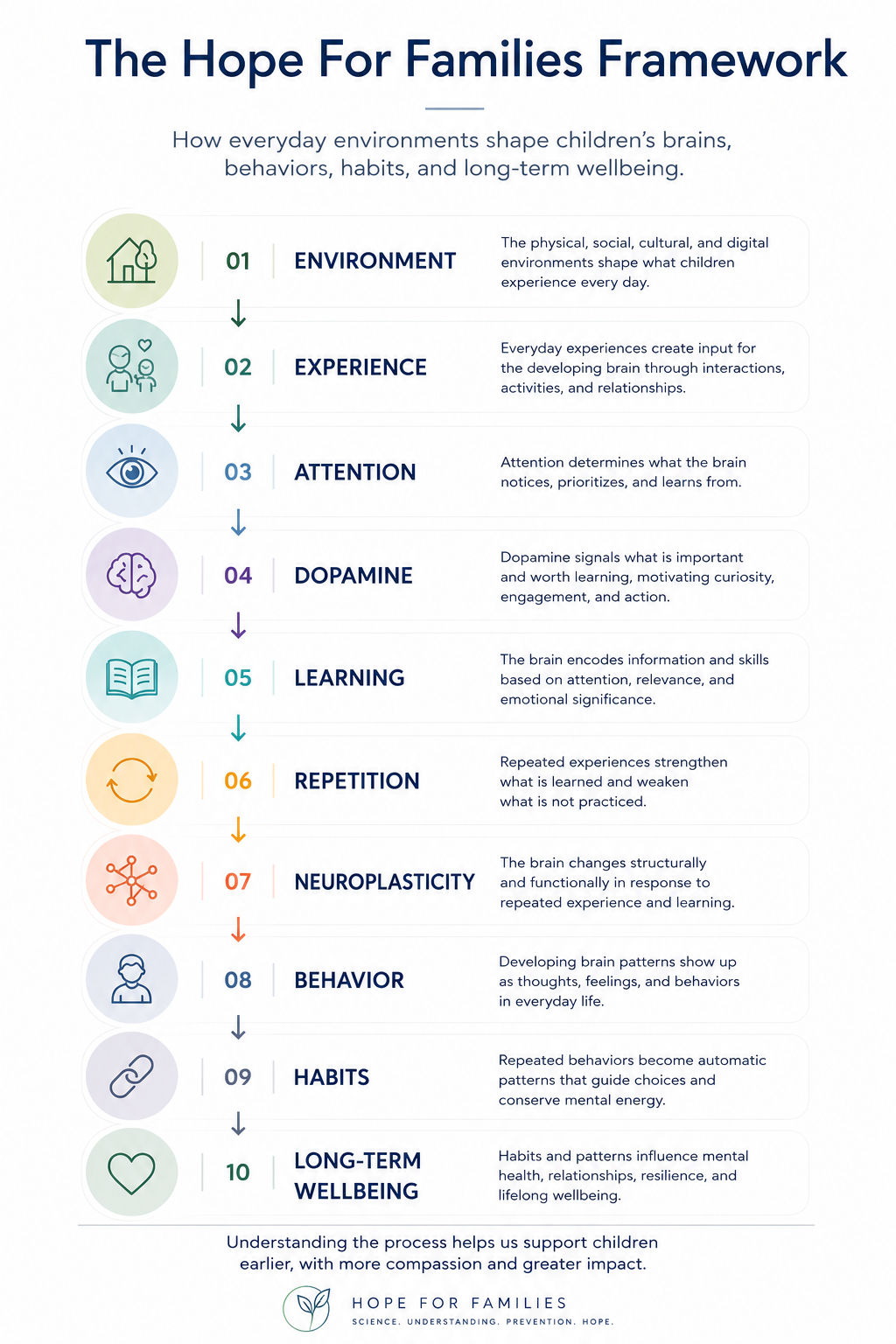
How to Read This Framework
This framework describes development as a continuous process.
Although the components are presented in sequence, development is not perfectly linear. Children constantly move back and forth between these processes as they interact with the world around them.
The framework should therefore be understood as a way of organizing complex developmental processes into a model that is easier to understand—not as a rigid step-by-step pathway.
The Components
The Hope For Families Framework describes development as a continuous process rather than a series of isolated events. Each component influences the next, creating a chain of experiences that gradually shapes how children think, feel, learn, and behave over time. While the components are presented in sequence for clarity, they interact continuously throughout development.
Environment → Experience → Attention → Dopamine → Learning → Repetition → Neuroplasticity → Behavior → Habits → Long-Term Wellbeing
Environment
Definition
Environment refers to the physical, social, emotional, and digital surroundings in which a child grows, learns, and interacts. It includes relationships, family life, routines, school and community settings, technology, physical spaces, and the broader social and cultural conditions that shape everyday experiences.
Why It Matters
Children develop through continuous interaction with the environments around them. These environments influence which experiences are available, what children encounter repeatedly, which opportunities and challenges arise, and the kinds of relationships, stimulation, stress, support, and learning experiences that become part of everyday life.
This is why the Hope For Families Framework begins with environment rather than behavior. Before we ask why a child behaves in a particular way, it can be useful to look upstream at the conditions and experiences surrounding that behavior.
Environment does not determine development on its own. Children differ in biology, temperament, developmental stage, previous experiences, and how they respond to the same surroundings. But over time, environments help shape the experiences from which attention, learning, adaptation, and behavior develop.
Everyday Example
Two children may have similar abilities but experience very different everyday environments. One may regularly have opportunities for outdoor play, family conversation, independent problem-solving, quiet periods, and sustained activities. Another may experience more frequent interruptions, less opportunity for independent exploration, and greater exposure to rapidly changing digital stimulation.
No single afternoon determines either child's development. But when different patterns of experience occur repeatedly over months and years, they can contribute to different patterns of attention, learning, behavior, and adaptation.
Related Concepts
Environment → Experience → Attention → Dopamine → Learning → Repetition → Neuroplasticity → Behavior → Habits → Long-Term Wellbeing
Experience
Definition
Experience refers to how a child encounters, perceives, interprets, and responds to what happens within their environment. Two children can encounter the same situation while experiencing it differently because of differences in development, previous learning, relationships, emotions, expectations, biological state, and individual characteristics.
Why It Matters
The environment provides the conditions in which development occurs, but children do not simply absorb those environments in identical ways. Development is shaped by how children interact with and experience what happens around them.
Experiences influence what captures attention, what feels safe or stressful, what becomes meaningful, what children learn, and how they respond to similar situations in the future. Over time, repeated experiences can contribute to expectations about relationships, effort, challenge, reward, safety, and the wider world.
This helps explain why the same environment does not produce the same developmental outcome for every child. Development emerges through the ongoing interaction between the child and their environment, with each new experience occurring within the context of what the child has already learned and experienced.
For this reason, understanding development requires more than asking what happened. It also requires considering how the child may have experienced what happened.
Everyday Example
Two children begin their first day of school in the same classroom. One experiences the unfamiliar environment with curiosity and excitement, while another feels uncertain and overwhelmed.
The classroom may be the same, but the children's experiences are not. Their temperament, previous experiences, relationships, expectations, and sense of safety can influence what they notice, how they respond, and what they begin learning about the new environment.
As similar experiences accumulate, these patterns can influence how each child approaches school, relationships, challenges, and learning in the future.
Related Concepts
Environment → Experience → Attention → Dopamine → Learning → Repetition → Neuroplasticity → Behavior → Habits → Long-Term Wellbeing
Attention
Definition
Attention refers to the processes through which the brain selectively prioritizes some information while filtering, reducing, or shifting away from other information. It helps determine which aspects of a child's internal and external environment receive greater processing at a given moment.
Attention is therefore more than simply concentrating. It is a dynamic system that continually responds to goals, expectations, emotions, novelty, perceived importance, sensory input, and what is happening in the environment.
Why It Matters
Children encounter far more information than the brain can process deeply at once. Attention helps prioritize which experiences receive greater processing and therefore have greater opportunity to influence learning and memory.
For this reason, attention acts as an important gateway between experience and learning. What repeatedly captures or receives a child's attention can influence what they notice, practice, remember, and become familiar with over time.
Attention is also shaped by context. Sleep, stress, emotional state, motivation, developmental stage, task difficulty, previous learning, and the surrounding environment can all influence a child's ability to direct and sustain attention.
This means that difficulty paying attention should not automatically be interpreted as a lack of effort or interest. Understanding attention requires considering both the capacities of the child and the conditions competing for or supporting their attention.
Everyday Example
Imagine a child trying to complete homework while short-form videos are playing on a tablet nearby. The homework requires sustained attention and effort, while the videos provide rapidly changing visual and auditory information.
The child's attention may repeatedly shift toward the more salient source of stimulation, even when they intend to complete the homework.
One evening like this does not determine the child's attentional development. But repeated environments can create repeated patterns of attention and practice. Over time, what children repeatedly attend to becomes part of the experiences from which learning develops.
Related Concepts
Environment → Experience → Attention → Dopamine → Learning → Repetition → Neuroplasticity → Behavior → Habits → Long-Term Wellbeing
Dopamine
Definition
Dopamine is a neurotransmitter involved in several brain functions, including motivation, learning, movement, reward processing, and the regulation of goal-directed behavior. Within learning and reward systems, dopamine helps signal when outcomes differ from expectations and contributes to how the brain learns which actions, cues, and experiences may be worth pursuing again.
Dopamine is often described as a “pleasure chemical,” but this is misleading. Its role is broader and more closely connected to learning, motivation, prediction, and action than to pleasure alone.
Why It Matters
As children interact with the world, their brains are continuously learning what predicts meaningful outcomes and which actions are worth repeating. Dopamine is one of several signaling systems involved in this process.
When an outcome is better, worse, or different from what was expected, changes in dopamine signaling can contribute to updating what the brain has learned. Through repeated experiences, these learning processes can influence expectations, motivation, choices, and future behavior.
This is particularly relevant during childhood because children are continually learning from relationships, play, challenges, feedback, achievement, technology, and countless other everyday experiences. Different environments provide different patterns of reward, effort, novelty, predictability, and feedback, all of which can shape learning.
Dopamine does not determine what children will enjoy, pursue, or become motivated by, nor can children's everyday behavior be explained by dopamine alone. Motivation and learning emerge through interactions between multiple brain systems, previous experiences, emotions, relationships, developmental stage, and the surrounding environment.
Understanding dopamine is therefore most useful when it helps explain one part of a larger developmental process rather than becoming a single explanation for children's behavior.
Everyday Example
Imagine a child working on a difficult puzzle. After trying several possibilities, one piece finally fits. The successful outcome provides feedback that can contribute to learning: the child discovers that continued effort and experimentation can lead to progress.
Now imagine a digital game providing frequent feedback through points, changing challenges, achievements, sounds, or unpredictable rewards. These experiences can also engage reward-learning processes, but the timing, frequency, predictability, and effort associated with the feedback may be very different.
Neither experience can be reduced to simply having “more” or “less” dopamine. What matters developmentally is what the child is experiencing and learning through repeated interactions with different kinds of activities and rewards.
Related Concepts
Understanding Motivation
Environment → Experience → Attention → Dopamine→ Learning → Repetition → Neuroplasticity → Behavior → Habits → Long-Term Wellbeing
Learning
Definition
Learning is the process through which experience produces relatively lasting changes in knowledge, skills, expectations, understanding, or behavior. Throughout childhood, children learn continuously as they interact with people, environments, challenges, information, and the consequences of their own actions.
Learning is not limited to deliberate instruction. Children also learn through observation, exploration, play, relationships, repetition, feedback, success, mistakes, and everyday experience.
Why It Matters
The developing brain is continually using experience to build and update its understanding of the world.
Children learn academic knowledge and practical skills, but they also learn what to expect from relationships, how effort relates to outcomes, which situations feel safe or stressful, how other people respond to them, what captures their attention, and which behaviors tend to produce particular results.
Attention plays an important role because information that receives greater processing has greater opportunity to contribute to learning. Motivation, emotion, previous knowledge, feedback, repetition, and the significance of an experience can also influence what is learned and how strongly that learning is retained.
Learning therefore does not simply mean storing information. It involves continually updating expectations and abilities based on experience.
This is why everyday environments matter. Children are learning even when nobody is intentionally teaching them. Repeated experiences can gradually teach patterns of responding, coping, interacting, persisting, avoiding, exploring, and seeking support.
Understanding learning allows us to ask not only What are we trying to teach this child? but also What might this child already be learning from the experiences surrounding them?
Everyday Example
Imagine a child who regularly encounters a difficult task.
If the child experiences manageable challenge, opportunities to try different approaches, enough time to persist, and support when needed, they may gradually learn that difficulty can be approached, explored, and sometimes overcome.
In another context, a child may repeatedly discover that leaving a difficult task immediately removes discomfort or provides access to a more appealing activity. Over time, that pattern can also become learned.
Neither response is explained by one experience alone. Learning develops as children encounter patterns of experience, action, feedback, and outcomes repeatedly over time.
Related Concepts
Understanding Neuroplasticity
Environment → Experience → Attention → Dopamine→ Learning → Repetition → Neuroplasticity → Behavior → Habits → Long-Term Wellbeing
Repetition
Definition
Repetition refers to experiences, actions, thoughts, emotional responses, or patterns of behavior that occur repeatedly over time. Through repetition, children receive recurring opportunities to practice skills, reinforce learning, build expectations, and become increasingly familiar with particular ways of responding to the world around them.
Repetition does not mean that every experience must occur in exactly the same way. Similar experiences across different situations can contribute to broader patterns of learning and development.
Why It Matters
A single experience can be meaningful, but development is often shaped by patterns that accumulate across time.
When children repeatedly practice a skill, encounter a particular type of challenge, experience similar responses from others, or use the same strategy in familiar situations, those experiences provide repeated opportunities for learning.
With practice and experience, some skills and responses can become more efficient, familiar, and increasingly automatic. Repetition can therefore contribute to the development of abilities, expectations, coping patterns, routines, and habits.
Importantly, repetition itself is neither inherently healthy nor unhealthy. Children can repeatedly practice persistence, movement, reading, emotional expression, problem-solving, and seeking support. They can also repeatedly practice avoidance or other responses that may become less helpful in particular contexts.
The developmental significance lies not simply in how often something happens, but in what is being experienced, learned, and reinforced through the repetition.
Repetition therefore provides an important bridge between learning and neuroplasticity within the Hope For Families Framework. Repeated learning experiences can contribute to lasting changes in how efficiently children process information, perform skills, form expectations, and respond to familiar situations.
Everyday Example
Imagine a child learning to ride a bicycle.
At first, balancing, steering, pedaling, and responding to changes in the environment require considerable attention and effort. Through repeated attempts, mistakes, adjustments, and successes, the child gradually becomes more skilled and the activity requires less conscious effort.
The important experience is not simply that the child performs the same movement again and again. Each attempt provides new information. The child adjusts, learns, and practices within slightly different circumstances.
The same broader principle applies across childhood. Repeated experiences provide opportunities for children to practice what they are learning until some skills, expectations, and responses become increasingly familiar and established.
Related Concepts
Understanding Neuroplasticity
Environment → Experience → Attention → Dopamine→ Learning → Repetition → Neuroplasticity → Behavior → Habits → Long-Term Wellbeing
Neuroplasticity
Definition
Neuroplasticity refers to the brain's capacity to change and adapt in response to experience, learning, development, and changing demands.
These changes can occur at multiple levels of the nervous system, including changes in the strength and organization of neural connections and in how networks of brain regions function together. Neuroplasticity occurs throughout life, but it is especially important during childhood, when the brain is undergoing extensive development and experience-dependent change.
Why It Matters
Children's brains are not simply growing according to a fixed biological program. Development emerges through an ongoing interaction between biological processes and experience.
As children learn, practice skills, interact with other people, adapt to challenges, and repeatedly engage with their environments, the nervous system can change in ways that support increasingly efficient and adapted patterns of processing and responding.
This does not mean that every repeated experience produces a permanent change in the brain. Neuroplasticity is influenced by many factors, including developmental stage, the nature and significance of an experience, attention, learning, repetition, biological processes, and the wider developmental context.
It also does not mean that development becomes permanently fixed once a pattern has formed. The brain remains capable of change. Existing patterns can be modified as children encounter new experiences, learn new skills, receive support, and adapt to changing environments.
This is one reason early experiences matter without making early development destiny. Experience can shape development, while the continuing capacity for neuroplasticity allows learning and adaptation to continue.
Within the Hope For Families Framework, neuroplasticity helps explain how patterns of learning and repeated experience can become increasingly established and influence how children respond in the future.
Everyday Example
Imagine a child learning to read.
At first, recognizing letters, connecting them with sounds, combining sounds into words, and understanding sentences require considerable effort and attention.
Through instruction, practice, feedback, and repeated reading experiences, the brain gradually adapts to these demands. Processes that were initially slow and effortful can become increasingly efficient, allowing more attention to shift from decoding individual words toward understanding their meaning.
The child's brain has not simply stored more information. Learning and repeated experience have contributed to changes in how the brain processes the task.
Neuroplasticity is therefore not something unusual that happens only after major experiences. It is part of the biological capacity that allows children to learn, adapt, and develop throughout childhood.
Related Concepts
Environment → Experience → Attention → Dopamine→ Learning → Repetition → Neuroplasticity→ Behavior → Habits → Long-Term Wellbeing
Behavior
Definition
Behavior refers to the observable actions and responses through which children interact with people, situations, and environments.
Behavior can reflect many interacting influences, including learning, emotions, attention, motivation, developmental capacities, physiological states, expectations, relationships, and the immediate context in which the behavior occurs.
For this reason, the same behavior can emerge for different reasons, and similar experiences can produce different behavioral responses in different children.
Why It Matters
Behavior is often the part of development adults notice first.
A child refuses a task, leaves their seat, becomes frustrated, withdraws, seeks reassurance, persists through difficulty, helps another child, or repeatedly asks for the same activity. These behaviors are visible, while many of the processes contributing to them are not.
Within the Hope For Families Framework, behavior therefore appears relatively late in the sequence.
Environment → Experience → Attention → Dopamine → Learning → Repetition → Neuroplasticity → Behavior
This does not mean every behavior can be traced through this sequence in a simple or linear way. Rather, the Framework encourages us to look beyond the behavior itself and consider the developmental processes and repeated experiences that may be contributing to it.
Behavior can also influence what happens next. Children's actions change their environments, shape how other people respond, and create new experiences from which further learning can occur. Development is therefore interactive rather than one-directional.
Understanding behavior means asking not only What is this child doing? but also What might be contributing to this behavior, and what is the child experiencing and learning around it?
Everyday Example
Imagine a child who repeatedly avoids difficult schoolwork.
From the outside, the behavior may look like unwillingness, poor motivation, or lack of effort. But several different processes could contribute to the same behavior.
The work may feel too difficult. The child may expect failure, struggle to sustain attention, feel anxious about making mistakes, have learned that avoidance removes discomfort, or simply lack some of the skills required for the task.
Another child displaying the same behavior may be responding for entirely different reasons.
The behavior matters, but understanding what surrounds and contributes to it gives adults much more useful information than the behavior alone.
Over time, behavioral responses can themselves become repeated experiences. What happens before, during, and after a behavior can influence what children learn and which responses become more likely in similar situations.
Related Concepts
Environment → Experience → Attention → Dopamine→ Learning → Repetition → Neuroplasticity→ Behavior → Habits → Long-Term Wellbeing
Habits
Definition
Habits are learned patterns of behavior that become increasingly automatic through repetition in recurring contexts.
As children repeatedly perform particular actions in similar situations, features of the environment can become associated with those actions. Over time, familiar cues and contexts may begin to prompt the behavior with less deliberate thought or conscious decision-making.
Habits can develop around many parts of everyday life, including routines, learning, movement, technology use, emotional responses, social interactions, and ways of approaching challenges.
Why It Matters
Not everything children do repeatedly becomes a habit. Repetition provides opportunities for habits to develop, but habit formation also depends on learning and the contexts in which behaviors occur.
A child may repeatedly put their shoes in the same place when coming home, begin reading after getting into bed, reach for a device during particular moments of boredom, or start packing their school bag after dinner. As the relationship between context and behavior becomes familiar, less conscious effort may be required to initiate the action.
This automaticity is one reason habits can be useful. They allow familiar behaviors to occur without requiring the same level of attention, planning, and decision-making every time.
But automaticity also means that changing an established habit can require more than simply telling a child to behave differently. It may involve changing the cues, environments, routines, or responses surrounding the behavior while repeatedly practicing an alternative.
Habits are therefore not fixed traits. They are learned patterns that develop within particular contexts and can continue to change as experiences and environments change.
Within the Hope For Families Framework, habits emerge from the interaction between previous learning, repeated behavior, and the environments in which those behaviors occur.
Everyday Example
Imagine a child who comes home from school each afternoon and immediately places their backpack beside the door, takes out their lunchbox, and puts it in the kitchen.
At first, an adult may need to remind the child of each step. But when the sequence occurs repeatedly in the same context, the routine can gradually require less prompting and conscious thought.
Eventually, walking through the door after school may itself help cue the familiar sequence.
The same process can occur with many different behaviors. Children can develop habits around reading, movement, hygiene, studying, device use, bedtime, helping at home, or responding to familiar situations.
Understanding habits therefore shifts the question from simply How do we make children choose the right behavior every time? toward What environments and repeated experiences are making particular behaviors easier to begin and repeat?
Related Concepts
Environment → Experience → Attention → Dopamine→ Learning → Repetition → Neuroplasticity→ Behavior → Habits → Long-Term Wellbeing
Long-Term Wellbeing
Definition
Long-term wellbeing refers to the developing capacities and patterns that support how children function, adapt, relate to others, manage challenges, learn, and care for their physical and emotional health across development and into adulthood.
Wellbeing is not a fixed outcome reached at the end of childhood. It continues to develop through the ongoing interaction between biology, relationships, environments, experiences, learning, opportunities, challenges, and support throughout life.
Why It Matters
The experiences children have during development can contribute to patterns that extend beyond the situations in which they first emerged.
Skills can become more established. Expectations can influence future choices. Ways of responding to stress, relationships, challenge, effort, and reward can become increasingly familiar. Habits and routines can shape everyday behavior and, over time, contribute to broader developmental pathways.
This is why early development matters.
But early development is not destiny.
No single environment, experience, behavior, or habit determines a child's future wellbeing. Development remains dynamic, and children's pathways can change through new relationships, environments, learning experiences, opportunities, support, and continued adaptation.
Protective factors can also influence these pathways. Supportive relationships, emotional safety, opportunities to develop skills, healthy routines, community resources, and timely support can help children adapt even when they have experienced significant challenges.
Within the Hope For Families Framework, Long-Term Wellbeing therefore represents direction rather than destination. The patterns children repeatedly experience and practice can influence where development is heading, while the continuing capacity for learning and adaptation means that those pathways remain open to change.
This is also why prevention matters. Supporting healthy development early does not guarantee a particular future. It helps strengthen the conditions, capacities, and developmental pathways that can make healthier outcomes more likely over time.
Everyday Example
Imagine a child who gradually learns that difficult situations can be approached with support.
Across childhood, they experience manageable challenges, opportunities to try, permission to make mistakes, adults who help when needed, and repeated chances to recover after things go wrong.
No single experience creates resilience or guarantees future wellbeing. But across time, these experiences can contribute to skills, expectations, and patterns that help the child approach later challenges with greater confidence and flexibility.
Another child may have experienced very different patterns earlier in life. That does not mean their developmental pathway is fixed. New relationships, supportive environments, learning, intervention, and repeated experiences of safety and success can continue to influence development.
Long-term wellbeing is therefore not the inevitable result of what happened early.
It is something that continues to develop.
Related Concepts
The Hope For Families Perspective
If there is one idea at the heart of the Hope For Families Framework, it is this:
Children are continuously adapting to the environments they repeatedly experience.
Everyday life is constantly teaching the developing brain what deserves attention, what is rewarding, what should be repeated, and what can safely be ignored. Over time, these repeated experiences gradually shape learning, strengthen neural pathways, influence behavior, form habits, and contribute to long-term wellbeing.
This does not mean that childhood is determined by a single experience, a difficult season, or one parenting decision. Development is far more dynamic than that. The brain remains remarkably adaptable throughout childhood, and small, consistent changes in everyday experiences can accumulate into meaningful developmental change over time.
The Hope For Families Framework is not intended to simplify child development into a single explanation. Rather, it offers a practical way of organizing well-established scientific principles into a coherent model that helps parents, educators, and professionals ask better questions.
Instead of asking:
"How do I change this behavior?"
the framework encourages us to ask:
"What experiences are shaping this behavior?"
That shift in perspective changes more than our understanding of children. It changes how we respond to them.
When we begin looking beyond behavior and toward the environments, relationships, and repeated experiences that shape development, we move from managing symptoms to supporting growth. That is where prevention begins.
Framework Principle
Children are not only shaped by what happens to them. They are shaped by what happens to them repeatedly. Understanding those repeated experiences is the first step toward supporting healthy development.